
Study OAS ·
BRICS Adopts New Delhi Declaration 2026
What’s the News?
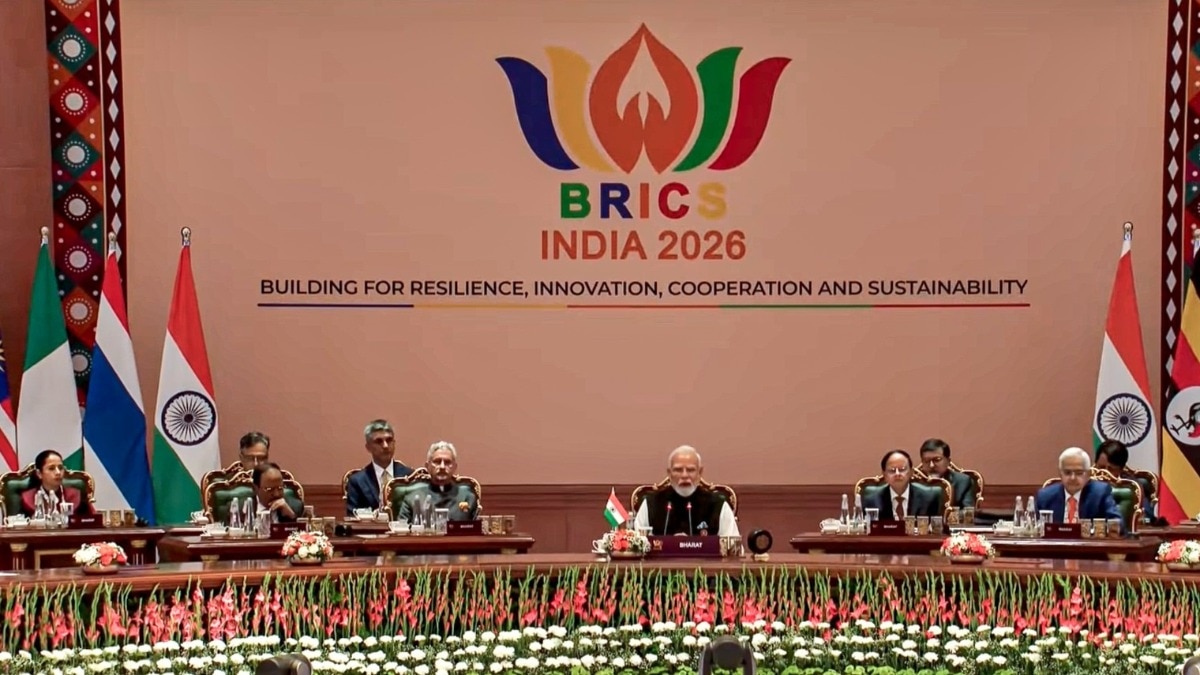
- BRICS leaders unanimously adopted the New Delhi Declaration 2026 during the 18th BRICS Summit at Bharat Mandapam, New Delhi.
- The declaration contains 140 points covering global governance, peace and security, terrorism, trade, finance, energy, technology, sustainable development and people-to-people cooperation.
- India chaired BRICS in 2026 under the theme “Building for Resilience, Innovation, Cooperation and Sustainability.”
- Prime Minister Narendra Modi stressed reform of global institutions and proposed mechanisms to improve continuity and implementation of BRICS decisions.
New Delhi Declaration
Global Governance and UN Reform
- BRICS called for comprehensive reform of the United Nations, including the UN Security Council (UNSC), to make it more representative, democratic, effective and responsive.
- It sought greater representation of developing countries from Africa, Asia and Latin America, strengthening the voice of the Global South.
- China and Russia, both permanent members of the UNSC, reiterated support for the aspirations of India and Brazil to play a greater role in the UN, including the Security Council.
- The declaration also recognised Africa's aspirations reflected in the Ezulwini Consensus and Sirte Declaration.
Terrorism and Pahalgam Attack
- BRICS condemned terrorism in all forms and manifestations, irrespective of motivation or perpetrators.
- It specifically condemned the Pahalgam terrorist attack in Jammu and Kashmir, in which 26 people were killed.
- Members called for action against:
- Cross-border movement of terrorists.
- Terror financing.
- Terrorist safe havens.
- BRICS reiterated zero tolerance for terrorism and rejected double standards in counter-terrorism.
Trade and WTO Reform
- BRICS expressed concern over the rise of unilateral tariffs and non-tariff measures that distort trade and disrupt global supply chains.
- It reaffirmed support for an open, inclusive, non-discriminatory and rules-based multilateral trading system centred on the WTO.
- Members called for restoration of a fully functioning two-tier WTO dispute-settlement mechanism, including appointment of members to the Appellate Body.
- BRICS also opposed unilateral coercive economic measures contrary to international law.
Cross-Border Payments and Local Currencies
- The BRICS Payment Task Force (BPTF) will continue exploring efficient cross-border payment mechanisms.
- Members recognised work towards:
- Interoperability of payment and financial-messaging systems.
- Faster and lower-cost cross-border payments.
- Greater use of BRICS members' local currencies for trade settlements and investments.
- The declaration clarified that such arrangements should respect national priorities rather than follow a single common model.
New Development Bank
- BRICS reaffirmed the importance of the New Development Bank (NDB) in financing infrastructure and sustainable development in emerging and developing economies.
- It supported greater:
- Local-currency financing.
- Resource mobilisation.
- Diversification of funding sources.
- Expansion of NDB membership.
- The declaration welcomed the BRICS-NDB Knowledge Portal, launched under India's chairship to share development experiences, policy innovations and lessons from NDB-financed projects.
Peace, West Asia and Nuclear Risks
- BRICS reiterated that international disputes should be resolved through dialogue, consultation and diplomacy.
- It expressed concern over escalating tensions in West Asia/Middle East, calling for restraint, protection of civilians and maintenance of global trade, supply chains and energy flows.
- Members also highlighted increasing risks associated with nuclear conflict.
- The declaration emphasised protection of seafarers and commercial shipping routes during geopolitical crises.
India’s Institutional Proposals
- BRICS Continuity and Implementation Mechanism
- Proposed by Prime Minister Modi to ensure initiatives continue despite the annually rotating BRICS chairship.
- Follow-up would be supported through the BRICS Troika, improving institutional continuity and implementation of summit decisions.
- Seafarers Emergency Support Network
- Proposed to link maritime authorities and diplomatic missions of participating countries.
- Intended to provide faster assistance to seafarers during emergencies and geopolitical disruptions.
Technology and Sustainable Development
- BRICS recognised Artificial Intelligence (AI) as an important driver of economic growth and sustainable development.
- Members supported safe, secure, inclusive and reliable AI and implementation of the BRICS Leaders’ Statement on Global Governance of Artificial Intelligence.
- The declaration acknowledged India's AI Impact Summit 2026.
- It also supported cooperation on smart grids, energy storage, disaster-risk reduction, climate-resilient infrastructure and digital public infrastructure.
Additional Info
- BRICS
- Originally emerged as BRIC — Brazil, Russia, India and China.
- South Africa's entry led to the name BRICS.
- Cooperation operates mainly through three pillars:
- Political and security cooperation.
- Economic and financial cooperation.
- Cultural and people-to-people cooperation.
- New Development Bank
- Established by BRICS countries to mobilise resources for infrastructure and sustainable-development projects.
- Headquarters: Shanghai, China.
- It is commonly referred to as the BRICS Bank.
- India’s BRICS Chairship 2026
- Theme: Building for Resilience, Innovation, Cooperation and Sustainability.
- The New Delhi Declaration marked the culmination of India's efforts to deepen BRICS cooperation while increasing representation of the Global South in international institutions.
- China will hold the BRICS Chairship in 2027 and host the 19th BRICS Summit.