
Study OAS ·
Landmark India–UK Free Trade Agreement Signed
What’s New?
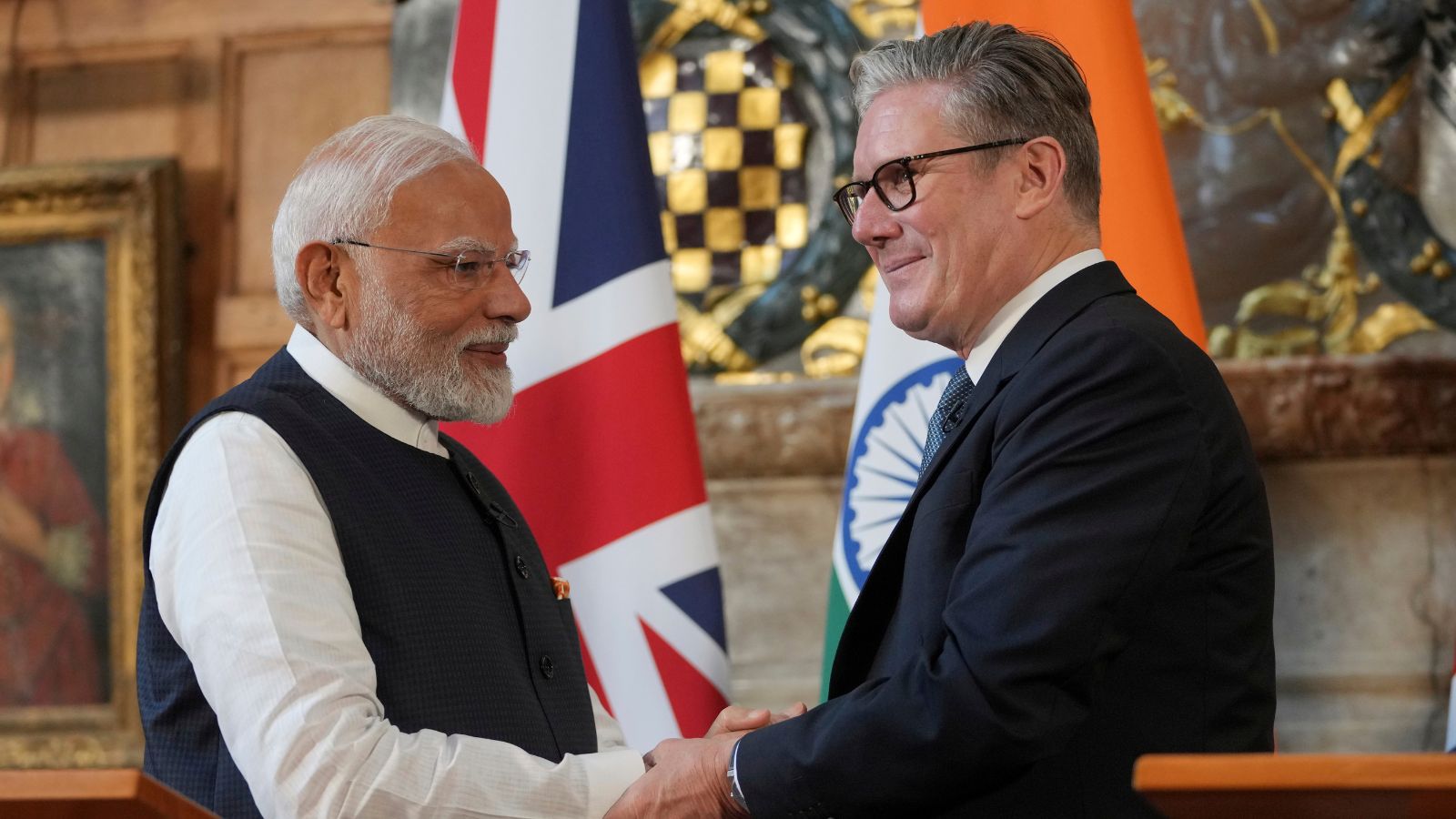
- On 24 July 2025, Prime Ministers Narendra Modi and Keir Starmer formally signed the India–UK Free Trade Agreement (FTA) at Chequers, marking a historic milestone in bilateral trade relations.
- Negotiations between the two countries began in January 2022, and an “agreement in principle” was reached on 6 May 2025.
- The deal is expected to boost bilateral trade by £25.5 billion annually by 2040, with a goal to double trade to US $120 billion by 2030.
- The agreement will slash average Indian tariffs on UK goods from ~15% to ~3%, and eliminate duties on 99% of Indian exports to the UK, covering ~100% of trade value.
Key Provisions
- Whisky & Alcohol: Duties on British Scotch whisky will fall from 150% to 75% immediately, reaching 40% within 10 years; similar phased cuts on gin, rum, brandy.
- Automobiles: India will phase down import duties on UK cars (including luxury vehicles) to 10% within 5–15 years, under quota restrictions (10,000 units rising to 19,000 by year five). Only select models qualify to preserve domestic IR competitiveness.
- Exports from India: Duty-free access to sectors like textiles, apparel, gems, jewelry, leather, machinery, pharma, processed foods, and marine products.
- Trade Facilitation & Services:
- Customs simplification: electronic authentication, clearance within 48 hours, periodic duty payments.
- Social security exemption for Indian workers posted in the UK (up to three years), including yoga instructors, chefs, musicians.
- Covers trade in goods, services, digital trade, professional mobility, SPS standards, etc..
Additional Info
- India–UK FTA (CETA):
- Officially titled India – United Kingdom Comprehensive Economic and Trade Agreement, signed 24 July 2025.
- Covers chapters on goods, services, IPR, digital trade, labour, environment, and dispute settlement.
- Trade Context:
- Bilateral trade in FY 2024–25: US $23.16 billion, with India enjoying a surplus of ~US $5.94 billion.
- UK is India’s sixth-largest investor; India is one of the UK’s top FDI sources.
Simplified Summary
- Historic FTA signed after ~3½ years of talks.
- Significant tariff cuts: average from 15% → 3% on UK goods; 99% of Indian exports duty-free to UK.
- Whisky tariff halved, auto duties slashed under quota, benefits capped for selected models.
- Big gains for textiles, gems, pharma, processed foods, machinery.
- Includes trade facilitation, digital and services cooperation, ease of temporary workforce movement.
- Projected annual trade uplift of £25.5 billion by 2040; aims to reach US $120 billion by 2030.
Exam Focus Points
- Significance: India’s first FTA in over a decade; UK’s fourth since Brexit.
- Tariff reductions: Whisky (150% → 75% → 40%), cars (to 10% under a quota), duty-free for most Indian exports.
- Covered sectors: Key for employment-intensive industries like textiles, leather, gems, marine, pharma.
- Trade facilitation: Includes digital customs, speedy clearance, social security exemption for temporary personnel.
- Strategic context: Diversifies India’s trade partnerships beyond the EU and US; strengthens UK’s global trade links.
- Challenges: Concerns over labour rights, environmental safeguards, and market access limits (e.g. car quotas).
- Implementation: Will require ratification by both parliaments; expected to be in force within a year.