
Current Affairs
Stay updated with the latest national and international events.
03 December 2025
WHO Endorses GLP-1 Drugs for Obesity

What’s the News?
The World Health Organization (WHO) has released its first-ever global guideline endorsing GLP-1 receptor agonists (e.g., semaglutide, tirzepatide, liraglutide) for long-term obesity management in adults. The move reframes obesity as a chronic, progressive, and relapsing disease, warranting sustained, person-centred care rather than short-term lifestyle interventions alone.
What are GLP-1 Receptor Agonists?
- Mechanism: They mimic the GLP-1 hormone released by the gut after eating.
- Key Actions:
- Brain: Targets satiety centers to reduce appetite and cravings.
- Stomach: Slows gastric emptying, making one feel full longer.
- Pancreas: Stimulates insulin release and inhibits glucagon, helping regulate blood sugar.
GLP-1 Guideline
- Conditional endorsement of GLP-1 therapies for adults with BMI ≥30, excluding pregnant women.
- Mandates structured behavioural support alongside pharmacotherapy:
- Healthy diet plans
- Regular physical activity
- Ongoing counselling
- Recommendation is conditional due to:
- Limited long-term data on safety & discontinuation
- High costs and supply constraints
- Equity concerns: <10% of eligible global population may access by 2030.
India’s Obesity Burden & Policy Gaps
- NFHS-5 (2019–21):
- 24% of women and 22.9% of men are overweight/obese.
- Rural obesity surged sharply: women (8.6% → 19.7%), men (7.3% → 19.3%).
- Obesity is a key driver of India’s NCD epidemic, responsible for 63% of all deaths.
- ICMR-INDIAB-23 confirms high prevalence of metabolic obesity, even among normal-BMI individuals.
Current Access to GLP-1 Drugs in India
- Semaglutide (Wegovy®) and tirzepatide (Zepbound®/Mounjaro®) available, but costly:
- Monthly cost: ₹16,000–₹20,000.
- Novo Nordisk reduced Wegovy’s price by 37% to improve access.
- Semaglutide’s patent expiry in India expected in 2026, likely to trigger biosimilar entry and price disruption.
Sources
Child Marriage Trends: Madhya Pradesh Sees Rise

What’s the News?
- Child marriage cases continue to rise in Madhya Pradesh, with 538 incidents reported in 2025, marking a 47% increase compared to 2020.
- The data, tabled in the Madhya Pradesh Legislative Assembly, identifies specific "hotspot" districts where the practice remains rampant despite government interventions.
- Recent studies highlight a concerning trend of "district-level inequality," where child marriage persists in specific clusters (hotspots) even as the national average declines.
Child Marriage Hotspot: Patterns & Drivers
- Persistent regional clusters: Bundelkhand, Central MP, Gwalior–Chambal, and tribal belts show entrenched prevalence.
- Steady rise statewide: Cases climbed from 366 (2020) → 436 (2021) → 519 (2022) → 528 (2023) → 529 (2024) → 538 (2025).
- Key drivers:
- Socio-economic deprivation and gender inequality.
- Weak local governance and poor scheme outreach.
- Cultural normalization of early unions in select communities.
Prohibition of Child Marriage Act (PCMA), 2006: Gaps in Enforcement
- Legal framework:
- Prohibits marriage of girls <18 years and boys <21 years.
- Penalties: Up to 2 years imprisonment and/or fine for adult male contracting party or guardian arranging marriage.
- District Magistrate functions as ex-officio Child Marriage Prohibition Officer (CMPO) in each district.
- Implementation gaps:
- Low conviction rates due to underreporting, social pressure, and lack of witness protection.
- Inconsistent CMPO appointment and capacity (many districts lack dedicated officers).
- Conflict between statutory law and personal/customary practices in tribal areas.
Additional Info
- Legal Framework:
- Prohibition of Child Marriage Act (PCMA), 2006: Defines child marriage as a marriage where the male is under 21 or the female is under 18. Offenders face up to 2 years imprisonment and/or ₹1 lakh fine.
- Voidable: Marriages are voidable at the option of the "child" party within two years of attaining majority.
- Proposed Amendment: The Prohibition of Child Marriage (Amendment) Bill, 2021 seeks to raise the marriage age for women to 21 years.
- Global Goals:
- SDG Target 5.3: Aims to eliminate all harmful practices, including child, early, and forced marriage, by 2030.
- National Statistics:
- According to NFHS-5 (2019-21), 23.3% of women aged 20-24 were married before age 18.
- India accounts for one in three child brides globally.
Sources
INDIA STRENGTHENS SEA-BASED DETERRENCE & NAVAL SELF-RELIANCE

What’s the News?
- INS Aridhaman, India’s third indigenously built nuclear-powered ballistic missile submarine (SSBN), has entered final trials and is set for commissioning soon, as confirmed by Navy Chief Admiral Dinesh K. Tripathi.
- INS Taragiri, the fourth stealth frigate of the Nilgiri-class (Project 17A) and third built by Mazagon Dock Shipbuilders Ltd (MDL), was delivered to the Indian Navy on November 28, 2025.
INS Aridhaman
- Class & Role: Third Arihant-class SSBN, designed for assured second-strike capability under India’s no-first-use nuclear doctrine.
- Displacement & Dimensions:
- 7,000 tonnes submerged (up from ~6,000 tonnes for INS Arihant).
- Length: ~130 m; Beam: 11–15 m; Draft: 9.5–10 m.
- Propulsion & Reactor:
- Powered by an indigenous 83 MW Compact Light Water Reactor (CLWR) developed by Bhabha Atomic Research Centre (BARC).
- Submerged speed: up to 24 knots; near-unlimited endurance.
- Enhanced stealth features include reduced acoustic signature.
- Armament:
- Four vertical launch tubes, capable of carrying:
- Up to 24 K-15 Sagarika SLBMs (750 km range)
- Or K-4 SLBMs (3,500 km range) — significantly extending deterrence reach.
- Four vertical launch tubes, capable of carrying:
- Strategic Significance:
- Will enable India’s first minimum credible triad rotation — one SSBN on patrol, one in refit, one in reserve — ensuring continuous at-sea deterrence (CASD).
- Part of the Advanced Technology Vessel (ATV) Project, with >90% indigenous content.
INS Taragiri
- Class & Programme: Fourth of seven Project 17A frigates, designed by the Warship Design Bureau (WDB) and built by MDL.
- Capabilities:
- Multi-mission stealth platform with integrated combat systems:
- BrahMos supersonic cruise missiles
- MFSTAR AESA radar + MRSAM point-defence system
- Anti-submarine: torpedoes, rockets, and hull-mounted sonar
- Close-in weapon systems: 30 mm and 12.7 mm guns
- CODOG propulsion (Combined Diesel or Gas) with Controllable Pitch Propellers (CPP) and Integrated Platform Management System (IPMS).
- Multi-mission stealth platform with integrated combat systems:
- Indigenisation & Economic Impact:
- 75% indigenous content, involving >200 MSMEs.
- Generated ~4,000 direct and >10,000 indirect jobs.
- Build time reduced to 81 months (vs. 93 for lead ship Nilgiri).
Sources
India Hosts World Summit on Disaster Management 2025
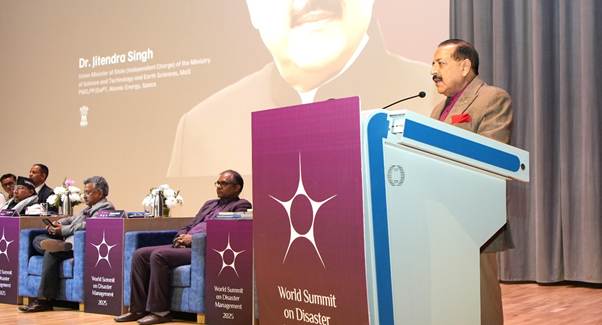
What’s the News?
India hosted the World Summit on Disaster Management (WSDM) 2025 in Dehradun, organized by the National Institute of Disaster Management (NIDM) under the Ministry of Home Affairs. Union Minister Dr. Jitendra Singh announced a significant expansion of early-warning infrastructure in Uttarakhand, including:
- 6 Doppler Weather Radars
- 33 Automatic Rain Gauge-cum-Observatories
- 142 Automatic Weather Stations (AWS)
The summit brought together global experts to advance science-based disaster resilience, especially in fragile ecosystems like the Himalayas.
WSDM 2025: Objectives & Strategic Focus
- Theme: “Science-Driven Disaster Resilience for a Climate-Vulnerable World”.
- Key Aims:
- Strengthen multi-hazard forecasting systems for cloudbursts, landslides, GLOFs (Glacial Lake Outburst Floods), and forest fires.
- Promote integration of AI, remote sensing, and “Nowcast” (3-hour hyperlocal forecast) systems in DRR.
- Foster public-private-academia-industry partnerships for scalable solutions.
- Institutional Anchors:
- Hosted in partnership with IMD, WMO, UNDRR, and GIZ.
- Aligns with India’s G20 presidency legacy on disaster-resilient infrastructure.
Himalayan-Specific Interventions Announced
- Enhanced Monitoring:
- Expansion of snow and glacier observatories in upper Himalayas.
- Real-time GLOF risk assessment using satellite + ground sensor fusion.
- Technology Integration:
- Deployment of AI-powered landslide early-warning systems in 15 high-risk districts.
- Pilot rollout of “Nowcast” alerts to 50 vulnerable blocks by mid-2026.
- Livelihood Resilience:
- Promotion of agri-startups working on climate-resilient crops.
- CSIR value-addition models for forest-based livelihoods to reduce deforestation pressure.
Policy & Governance Linkages
- Sendai Framework Target E: India now has state & district DRR strategies in all 780 districts (100% coverage).
- 15th Finance Commission Recommendation:
- 10% of SDRF (State Disaster Response Fund) must be used for local mitigation, ensuring bottom-up resilience.
- NDMA Roadmap 2030:
- Focus on disaster-proofing critical infrastructure (roads, hospitals, schools).
- Scaling up community-based DRR training via NIDM’s Viksit Bharat DRR Fellows initiative.
Additional Info
- Constitutional Context:
- Entry 23, Concurrent List: “Social security and social insurance; employment and unemployment”—covers DRR workforce development.
- Article 21: Right to life interpreted to include protection from avoidable disaster deaths (Chandrabhan Sharma v. Union of India, 2011).
- Key Statistics:
- India loses ~0.47% of GDP annually to disasters (NCAER estimate).
- Every ₹1 invested in DRR yields ₹7–15 in avoided losses (World Bank).
- Global Commitments:
- COP28 UAE Declaration on Early Warnings for All by 2027 – India progressing ahead of schedule in Himalayan states.
- Supports SDG 11 (Sustainable Cities), SDG 13 (Climate Action), and SDG 17 (Partnerships).
Sources
International Day of Persons with Disabilities 2025

What’s the News?
On December 3, 2025, India observed the International Day of Persons with Disabilities (IDPD) with President Droupadi Murmu presenting the National Awards for the Empowerment of Persons with Disabilities 2025, recognizing outstanding contributions by individuals and institutions toward inclusion and accessibility.
IDPD 2025: Theme & Global Priority
- UN-WHO Theme: “Inclusive Financing for Sustainable Development” - emphasizing that equitable financing mechanisms are critical to closing access gaps in health, education, transport, and digital services.
- Recognises that persons with disabilities are 2–4× more vulnerable during disasters and health emergencies - linking DRR and healthcare inclusion to IDPD goals.
India’s Domestic Framework & Progress
- Rights of Persons with Disabilities (RPwD) Act, 2016:
- Expanded disability coverage from 7 to 21 categories, including acid attack victims, dwarfism, Parkinson’s, thalassemia, sickle cell disease, and specific learning disabilities.
- Mandates 5% reservation in government jobs and 5% seats in higher education for persons with ≥40% benchmark disabilities.
- Sugamya Bharat Abhiyan (Accessible India Campaign):
- 1,671 government buildings across 50 cities audited for accessibility; 1,630 retrofitted with ramps, signage, toilets, etc.
- 90 airports made accessible; 12 equipped with Ambulifts.
- Digital accessibility: Web audit phase-II underway; OTT accessibility guidelines notified in April 2025.
Policy Gaps & Forward Agenda
- Implementation challenges:
- Low awareness of RPwD entitlements in rural & tribal areas.
- Inconsistent enforcement of building by-laws (NBC 2016 Part 3).
- Limited availability of certified sign language interpreters and assistive devices.
- Way forward:
- Scale up Universal Design in infrastructure (AMRUT 2.0, PMAY-U).
- Integrate disability disaggregation in NFHS, NSSO, and SECC datasets for evidence-based policymaking.
- Leverage UDID (Unique Disability ID) portal for targeted delivery (6.2 crore+ enrolled as of 2025).
Additional Info
- Constitutional Linkages:
- Article 41: Directive Principle obligating the State to provide public assistance in cases of disability.
- Article 21: Right to life interpreted to include right to dignity, autonomy, and inclusive participation (Rajive Raturi v. UOI, 2016).
- International Commitments:
- India ratified UN Convention on the Rights of Persons with Disabilities (UNCRPD) in 2007.
- Supports SDG 10 (Reduced Inequalities) and SDG 11 (Inclusive Cities).
- Key Schemes:
- Deendayal Disabled Rehabilitation Scheme (DDRS): Capacity-building for NGOs
- ADIP Scheme: Subsidy for assistive devices (₹1.28 lakh crore allocated in 2025–26)
- National Fellowship for PwDs: For M.Phil / Ph.D. pursuits
Sources
December 2025
Archive
November 2026
- 27 November 2026
- 26 November 2026
- 25 November 2026
- 24 November 2026
- 23 November 2026
- 21 November 2026
- 20 November 2026
- 19 November 2026
- 18 November 2026
- 17 November 2026
- 16 November 2026
- 14 November 2026
- 13 November 2026
- 12 November 2026
- 11 November 2026
- 10 November 2026
- 09 November 2026
- 06 November 2026
- 05 November 2026
- 04 November 2026
- 03 November 2026
- 02 November 2026
October 2026
- 31 October 2026
- 30 October 2026
- 29 October 2026
- 28 October 2026
- 27 October 2026
- 26 October 2026
- 24 October 2026
- 23 October 2026
- 22 October 2026
- 21 October 2026
- 20 October 2026
- 19 October 2026
- 17 October 2026
- 16 October 2026
- 15 October 2026
- 14 October 2026
- 13 October 2026
- 12 October 2026
- 10 October 2026
- 09 October 2026
- 08 October 2026
- 07 October 2026
- 06 October 2026
- 05 October 2026
- 03 October 2026
- 02 October 2026
- 01 October 2026
September 2026
- 30 September 2026
- 29 September 2026
- 28 September 2026
- 26 September 2026
- 25 September 2026
- 24 September 2026
- 23 September 2026
- 22 September 2026
- 21 September 2026
- 19 September 2026
- 18 September 2026
- 17 September 2026
- 16 September 2026
- 15 September 2026
- 12 September 2026
- 11 September 2026
- 10 September 2026
- 09 September 2026
- 08 September 2026
- 07 September 2026
- 05 September 2026
- 04 September 2026
- 03 September 2026
- 02 September 2026
- 01 September 2026
August 2026
- 31 August 2026
- 29 August 2026
- 27 August 2026
- 26 August 2026
- 25 August 2026
- 24 August 2026
- 22 August 2026
- 21 August 2026
- 20 August 2026
- 19 August 2026
- 18 August 2026
- 17 August 2026
- 14 August 2026
- 13 August 2026
- 12 August 2026
- 11 August 2026
- 10 August 2026
- 08 August 2026
- 07 August 2026
- 06 August 2026
- 05 August 2026
- 04 August 2026
- 03 August 2026
- 01 August 2026
July 2026
- 31 July 2026
- 30 July 2026
- 29 July 2026
- 28 July 2026
- 27 July 2026
- 25 July 2026
- 23 July 2026
- 22 July 2026
- 21 July 2026
- 20 July 2026
- 18 July 2026
- 17 July 2026
- 15 July 2026
- 14 July 2026
- 13 July 2026
- 11 July 2026
- 10 July 2026
- 09 July 2026
- 08 July 2026
- 07 July 2026
- 06 July 2026
- 04 July 2026
- 03 July 2026
- 02 July 2026
- 01 July 2026
June 2026
May 2026
April 2026
March 2026
- 31 March 2026
- 30 March 2026
- 28 March 2026
- 27 March 2026
- 26 March 2026
- 25 March 2026
- 24 March 2026
- 23 March 2026
- 21 March 2026
- 20 March 2026
- 19 March 2026
- 18 March 2026
- 17 March 2026
- 16 March 2026
- 14 March 2026
- 13 March 2026
- 12 March 2026
- 11 March 2026
- 10 March 2026
- 09 March 2026
- 07 March 2026
- 06 March 2026
- 05 March 2026
- 03 March 2026
- 02 March 2026
February 2026
- 28 February 2026
- 27 February 2026
- 26 February 2026
- 25 February 2026
- 24 February 2026
- 23 February 2026
- 21 February 2026
- 20 February 2026
- 19 February 2026
- 18 February 2026
- 17 February 2026
- 16 February 2026
- 13 February 2026
- 12 February 2026
- 11 February 2026
- 10 February 2026
- 09 February 2026
- 07 February 2026
- 06 February 2026
- 05 February 2026
- 04 February 2026
- 03 February 2026
- 02 February 2026
January 2026
- 31 January 2026
- 30 January 2026
- 29 January 2026
- 28 January 2026
- 27 January 2026
- 26 January 2026
- 24 January 2026
- 23 January 2026
- 22 January 2026
- 21 January 2026
- 20 January 2026
- 19 January 2026
- 16 January 2026
- 15 January 2026
- 14 January 2026
- 13 January 2026
- 12 January 2026
- 10 January 2026
- 09 January 2026
- 08 January 2026
- 07 January 2026
- 06 January 2026
- 05 January 2026
- 03 January 2026
- 02 January 2026
- 01 January 2026
December 2025
- 31 December 2025
- 30 December 2025
- 29 December 2025
- 27 December 2025
- 26 December 2025
- 24 December 2025
- 23 December 2025
- 22 December 2025
- 20 December 2025
- 19 December 2025
- 18 December 2025
- 17 December 2025
- 16 December 2025
- 15 December 2025
- 13 December 2025
- 12 December 2025
- 11 December 2025
- 10 December 2025
- 09 December 2025
- 08 December 2025
- 05 December 2025
- 04 December 2025
- 03 December 2025
- 02 December 2025
November 2025
- 29 November 2025
- 28 November 2025
- 27 November 2025
- 26 November 2025
- 25 November 2025
- 24 November 2025
- 22 November 2025
- 21 November 2025
- 20 November 2025
- 19 November 2025
- 18 November 2025
- 17 November 2025
- 15 November 2025
- 14 November 2025
- 13 November 2025
- 12 November 2025
- 11 November 2025
- 10 November 2025
- 08 November 2025
- 07 November 2025
- 06 November 2025
- 05 November 2025
- 04 November 2025
- 03 November 2025
- 01 November 2025
October 2025
- 31 October 2025
- 30 October 2025
- 29 October 2025
- 28 October 2025
- 27 October 2025
- 25 October 2025
- 24 October 2025
- 23 October 2025
- 22 October 2025
- 21 October 2025
- 20 October 2025
- 18 October 2025
- 17 October 2025
- 16 October 2025
- 15 October 2025
- 14 October 2025
- 13 October 2025
- 11 October 2025
- 10 October 2025
- 09 October 2025
- 08 October 2025
- 07 October 2025
- 06 October 2025
- 04 October 2025
- 03 October 2025
- 02 October 2025
- 01 October 2025
September 2025
- 30 September 2025
- 29 September 2025
- 27 September 2025
- 26 September 2025
- 25 September 2025
- 24 September 2025
- 23 September 2025
- 22 September 2025
- 20 September 2025
- 19 September 2025
- 18 September 2025
- 17 September 2025
- 16 September 2025
- 15 September 2025
- 13 September 2025
- 12 September 2025
- 11 September 2025
- 10 September 2025
- 09 September 2025
- 08 September 2025
- 06 September 2025
- 05 September 2025
- 04 September 2025
- 03 September 2025
- 02 September 2025
- 01 September 2025
August 2025
- 30 August 2025
- 29 August 2025
- 28 August 2025
- 27 August 2025
- 26 August 2025
- 25 August 2025
- 23 August 2025
- 22 August 2025
- 21 August 2025
- 20 August 2025
- 19 August 2025
- 18 August 2025
- 16 August 2025
- 14 August 2025
- 13 August 2025
- 12 August 2025
- 11 August 2025
- 08 August 2025
- 07 August 2025
- 06 August 2025
- 05 August 2025
- 04 August 2025
- 02 August 2025
- 01 August 2025
July 2025
- 31 July 2025
- 30 July 2025
- 29 July 2025
- 28 July 2025
- 26 July 2025
- 25 July 2025
- 24 July 2025
- 23 July 2025
- 22 July 2025
- 21 July 2025
- 19 July 2025
- 18 July 2025
- 17 July 2025
- 16 July 2025
- 15 July 2025
- 12 July 2025
- 11 July 2025
- 10 July 2025
- 09 July 2025
- 07 July 2025
- 05 July 2025
- 04 July 2025
- 03 July 2025
- 02 July 2025
- 01 July 2025
June 2025
- 30 June 2025
- 28 June 2025
- 27 June 2025
- 26 June 2025
- 25 June 2025
- 24 June 2025
- 23 June 2025
- 21 June 2025
- 20 June 2025
- 19 June 2025
- 18 June 2025
- 17 June 2025
- 16 June 2025
- 14 June 2025
- 13 June 2025
- 12 June 2025
- 11 June 2025
- 10 June 2025
- 09 June 2025
- 07 June 2025
- 06 June 2025
- 05 June 2025
- 04 June 2025
- 03 June 2025
- 02 June 2025
May 2025
April 2025
- 30 April 2025
- 29 April 2025
- 28 April 2025
- 26 April 2025
- 25 April 2025
- 24 April 2025
- 23 April 2025
- 22 April 2025
- 21 April 2025
- 19 April 2025
- 18 April 2025
- 17 April 2025
- 16 April 2025
- 15 April 2025
- 14 April 2025
- 12 April 2025
- 11 April 2025
- 10 April 2025
- 09 April 2025
- 08 April 2025
- 07 April 2025
- 05 April 2025
- 04 April 2025
- 03 April 2025
- 02 April 2025
- 01 April 2025
March 2025
- 31 March 2025
- 29 March 2025
- 28 March 2025
- 27 March 2025
- 26 March 2025
- 25 March 2025
- 24 March 2025
- 22 March 2025
- 21 March 2025
- 20 March 2025
- 19 March 2025
- 18 March 2025
- 17 March 2025
- 15 March 2025
- 13 March 2025
- 12 March 2025
- 11 March 2025
- 10 March 2025
- 08 March 2025
- 07 March 2025
- 06 March 2025
- 05 March 2025
- 04 March 2025
- 03 March 2025
- 01 March 2025
February 2025
- 28 February 2025
- 27 February 2025
- 26 February 2025
- 25 February 2025
- 24 February 2025
- 22 February 2025
- 21 February 2025
- 20 February 2025
- 19 February 2025
- 18 February 2025
- 17 February 2025
- 15 February 2025
- 14 February 2025
- 13 February 2025
- 12 February 2025
- 11 February 2025
- 10 February 2025
- 08 February 2025
- 07 February 2025
- 06 February 2025
- 05 February 2025
- 04 February 2025
- 03 February 2025
- 01 February 2025
January 2025
- 31 January 2025
- 30 January 2025
- 29 January 2025
- 28 January 2025
- 27 January 2025
- 25 January 2025
- 24 January 2025
- 23 January 2025
- 22 January 2025
- 21 January 2025
- 20 January 2025
- 18 January 2025
- 17 January 2025
- 16 January 2025
- 15 January 2025
- 14 January 2025
- 13 January 2025
- 11 January 2025
- 10 January 2025
- 09 January 2025
- 08 January 2025
- 07 January 2025
- 06 January 2025
- 04 January 2025
- 03 January 2025
- 02 January 2025
- 01 January 2025