
Current Affairs
Stay updated with the latest national and international events.
11 September 2026
NPCI Launches UPI Tap & Pay and AI-Powered MyUPI

What’s the News?
- The National Payments Corporation of India (NPCI) has launched UPI Tap & Pay and MyUPI (UPI Help 2.0) at the Global Fintech Fest (GFF) 2026 in Mumbai.
- The initiatives were unveiled by RBI Governor Sanjay Malhotra.
- UPI Tap & Pay enables contactless UPI payments by tapping an NFC-enabled smartphone on a compatible Point-of-Sale (PoS) terminal.
- MyUPI is an AI-powered platform designed to provide unified transaction information, customer support, fraud controls and dispute-resolution services across the UPI ecosystem.
UPI Tap & Pay
- Users can make payments by unlocking an NFC-enabled smartphone and tapping it on an NFC-enabled PoS terminal, without opening a UPI application.
- Mobile internet on the user's phone is not required; the transaction uses the PoS terminal's internet connection.
- UPI PIN-less limit: Up to ₹5,000.
- Transactions above ₹5,000 require the UPI PIN.
- It supports multiple UPI-linked account types, including RuPay Credit Card on UPI.
- NFC (Near Field Communication) is a short-range wireless technology that enables contactless communication between compatible devices.
MyUPI
- MyUPI, also described as UPI Help 2.0, is an AI-powered customer-support and control platform.
- It is built on NPCI's in-house Small Language Model (SLM), FiMI — Finance Model for India.
- It provides a single view of UPI transactions and AutoPay mandates across different banks and UPI applications.
- Major features include:
- Safety Switch: Users can request blocking of UPI debit transactions when account compromise is suspected.
- UPI Number Delink: Allows a mobile number to be delinked from receiving UPI payments.
- Payee Context-based Information: Provides additional information about a beneficiary before payment.
- Automated Chargeback Processing: Enables real-time creation of chargebacks for eligible transactions, reducing complaint-resolution time.
- Transaction Replay: Allows users to recall and repeat previous transactions through any UPI app.
- 24×7 multilingual self-service support.
UPI Biometric Authentication
- UPI biometric authentication, introduced at GFF 2025, allows authentication through methods such as fingerprint or facial recognition on supported devices.
- Cumulative biometric-authenticated UPI transactions had crossed 6.29 billion by the end of August 2026.
- The expansion of biometric authentication and Tap & Pay reflects UPI's movement towards lower-friction, faster payment authentication.
Additional Info
- National Payments Corporation of India (NPCI)
- Umbrella organisation for operating retail payment and settlement systems in India.
- An initiative of the Reserve Bank of India (RBI) and Indian Banks' Association (IBA).
- Established under the framework of the Payment and Settlement Systems Act, 2007.
- Incorporated as a not-for-profit company, presently under Section 8 of the Companies Act, 2013.
- Major NPCI platforms include UPI, RuPay, IMPS, NACH, AePS, BHIM and NETC.
- Unified Payments Interface (UPI)
- Developed and operated by NPCI.
- Introduced in 2016 as an interoperable real-time payment system.
- Enables multiple bank accounts to be accessed through compatible payment applications.
Sources
IMF Welcomes India’s Statistical Framework Modernisation
What’s the News?
- The International Monetary Fund (IMF) has welcomed India’s efforts to modernise its macroeconomic statistical framework.
- IMF Communications Director Julie Kozack said the incorporation of the new Index of Industrial Production (IIP) and Producer Price Index (PPI) series should improve the accuracy of India’s GDP estimates.
- The IMF also noted that India’s real GDP grew by 7.8% in the April–June quarter of 2026-27, exceeding its staff expectations.
- Stronger-than-expected activity in the services sector and exports contributed to the growth, reinforcing India’s position as a major contributor to global economic growth.
Statistical Framework Modernisation
India has undertaken major revisions to make economic statistics better reflect the current structure of the economy.
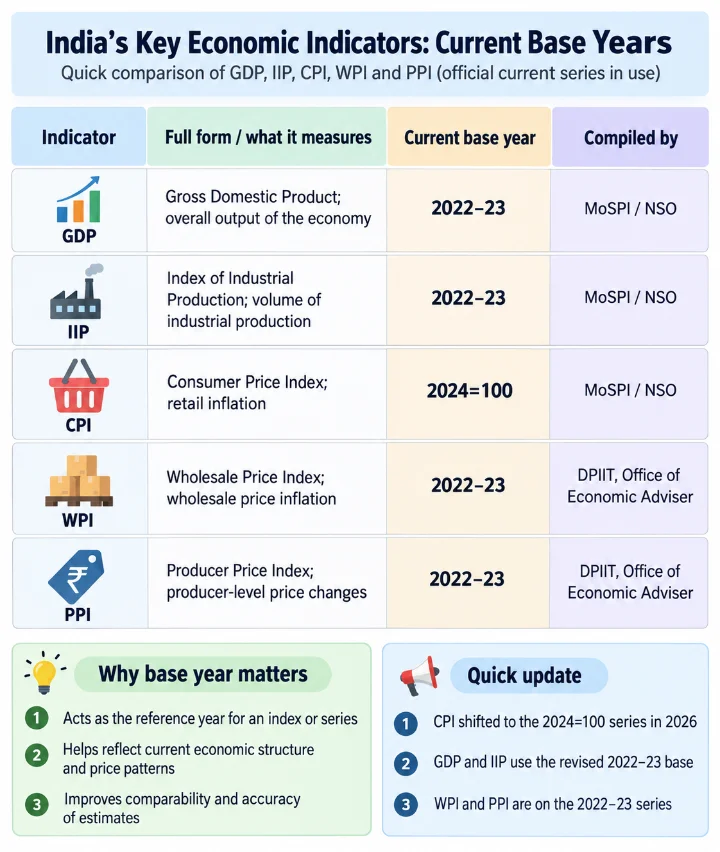
- GDP Base Year: Revised from 2011-12 to 2022-23.
- IIP Base Year: Revised from 2011-12 to 2022-23.
- PPI Base Year: 2022-23.
- The new IIP and PPI series were incorporated into national accounts after becoming available subsequent to the release of the new GDP series.
- Their incorporation represents an improvement in data inputs, rather than a change in the underlying National Accounts methodology.
New Index of Industrial Production
- IIP measures changes in the volume of industrial production over time.
- The new series has 2022-23 = 100 as its base.
- Its basket contains 463 item groups, including 120 new item groups.
- Coverage has been expanded to areas such as:
- Minor and rare-earth minerals
- Gas supply
- Water supply
- Sewerage and waste management
- Renewable and non-renewable electricity generation
- The current series uses National Industrial Classification (NIC)-2008, based on the UN's ISIC Revision 4.
Producer Price Index
- PPI measures changes in the prices received by domestic producers for their output.
- India introduced an Output PPI with base year 2022-23, along with a trial Input PPI and PPIs for selected services.
- PPI provides a more appropriate price measure for parts of the National Accounts and can improve the calculation of real GDP and Gross Value Added (GVA).
- It is being used selectively according to the characteristics of individual economic activities rather than replacing other price indices universally.
India’s GDP Performance
- Real GDP growth: 7.8% in the April–June quarter of 2026-27.
- Real GDP was estimated at about ₹81.36 lakh crore, compared with ₹75.46 lakh crore in the corresponding quarter of the previous year.
- The IMF attributed the stronger-than-expected performance particularly to services and exports.
- It described India as a key growth engine for the world, while encouraging continued improvements in statistical quality.
Additional Info
- Ministry of Statistics and Programme Implementation (MoSPI)
- Responsible for compilation and release of major official statistics such as GDP, IIP and CPI.
- Periodic base-year revision helps account for structural changes in production, consumption and relative prices.
- MoSPI generally aims for base revisions at roughly five-year intervals, in line with international recommendations.
- International Monetary Fund (IMF)
- Established following the Bretton Woods Conference of 1944.
- Headquarters: Washington, D.C., United States.
- Major functions include promoting international monetary cooperation, supporting exchange-rate and financial stability, conducting economic surveillance and providing financial assistance to member countries.
- India is a founding member of the IMF.
- Why Base-Year Revision Matters
- Updates sectoral weights and economic structure.
- Incorporates newer surveys and administrative databases.
- Improves measurement of real output by using more representative prices and production patterns.
- Helps GDP, inflation and industrial-production statistics reflect contemporary economic conditions more accurately.
Sources
Government Tightens E-Commerce Rules on Discounts and Digital Practices

What’s the News?
- The government has introduced the Consumer Protection (E-Commerce) (Amendment) Rules, 2026 to strengthen transparency and consumer protection in online marketplaces.
- The amended framework will replace the Consumer Protection (E-Commerce) Rules, 2020 and come into force from 2027.
- Major changes cover discount pricing, search results, sponsored listings, dark patterns, grievance redressal, consumer data and product disclosures.
Discount and Price Transparency
- When announcing a discount, an e-commerce entity must display:
- Reduced price, and
- Prior price.
- Prior price means the lowest price at which the good or service was offered during the preceding 30 days.
- This seeks to curb misleading discounts based on artificially inflated reference prices.
Search Results and Sponsored Listings
- Platforms cannot manipulate search results in a manner that:
- Misleads consumers, or
- Adversely affects the relevance of results to the user's search query.
- Paid/sponsored listings must carry clear and prominent disclosures, enabling consumers to distinguish advertisements from organic results.
Dark Patterns and Compliance
- E-commerce entities must comply with the Guidelines for Prevention and Regulation of Dark Patterns, 2023.
- They must:
- Conduct a yearly self-audit.
- Prominently display a certificate of compliance.
- Dark patterns are deceptive user-interface practices designed to manipulate consumers into decisions they may not otherwise make.
Consumer Protection Measures
- Every e-commerce entity must become a partner in the convergence process of the National Consumer Helpline (NCH).
- Consumers must receive a copy of the complaint recorded by the platform's grievance officer.
- Marketplace platforms must disclose important information such as:
- Best-before/use-before dates
- Return and refund conditions
- Warranty
- Delivery and payment details
- Importer details and country of origin for imported goods.
- Consumer information cannot be used for specified purposes without express and affirmative consent.
- Platforms cannot impose bundled fees for unrelated services, subject to exceptions for loyalty or membership programmes.
E-Commerce Grievances
- The National Consumer Helpline received 17,71,622 grievances in 2025.
- Of these, 5,11,196 complaints, or about 29%, were related to the e-commerce sector.
- India's e-commerce market is projected to expand from about $140 billion to as much as $300 billion by 2030.
- Online shoppers are projected to increase from around 280–300 million in 2025 to 420–440 million by 2030.
Additional Info
- Consumer Protection Act, 2019
- Provides the statutory framework for protecting consumer rights in India.
- It provides for the Central Consumer Protection Authority (CCPA) to address violations of consumer rights, unfair trade practices and misleading advertisements.
- Consumer Protection (E-Commerce) Rules, 2020
- Regulate e-commerce entities operating in India.
- The 2026 amendments strengthen these rules for evolving digital-market practices.
- Dark Patterns
- Examples include false urgency, basket sneaking, confirm shaming, forced action, subscription traps, interface interference, bait-and-switch, drip pricing and disguised advertisements.
- Their regulation seeks to preserve consumer autonomy and informed choice.
Sources
India Crosses 80 Lakh HPV Vaccinations in Cervical Cancer Prevention Drive

What’s the News?
- India has administered over 80 lakh doses of the Human Papillomavirus (HPV) vaccine under the nationwide cervical cancer prevention campaign.
- The programme targets 14-year-old girls and provides a single dose of Gardasil-4 free of cost at government health facilities.
- The campaign covers all 36 States and Union Territories and targets an annual cohort of about 1.2 crore eligible girls.
- Vaccination is voluntary and requires parental consent.
National HPV Vaccination Campaign
- Target group: Girls aged 14 years.
- Target population: Around 1.2 crore girls annually.
- Vaccine: Gardasil-4, a quadrivalent HPV vaccine.
- Schedule: Single dose.
- Cost: Free at designated government health facilities.
- Vaccination is available through:
- Ayushman Arogya Mandirs
- Primary Health Centres (PHCs)
- Community Health Centres (CHCs)
- Sub-District and District Hospitals
- Government Medical Colleges
- Beneficiary registration and vaccination tracking are supported through the U-WIN digital platform.
Vaccination Coverage
- More than 80 lakh doses have been administered since the national rollout.
- States reporting 100% coverage of their identified target populations include:
- Gujarat
- Uttar Pradesh
- Madhya Pradesh
- Mizoram
- Over 90% coverage: Bihar, Andhra Pradesh and Assam.
- Over 85%: Karnataka.
- Over 60%: Chhattisgarh, Sikkim, Kerala, Telangana and Odisha.
HPV and Cervical Cancer
- Human Papillomavirus (HPV) is a group of viruses, some types of which can cause cancers.
- Persistent infection with high-risk HPV types is the principal cause of cervical cancer.
- Gardasil-4 protects against four HPV types:
- HPV-16 and HPV-18: Major cancer-causing types.
- HPV-6 and HPV-11: Mainly associated with genital warts.
- Vaccination before significant exposure to HPV provides preventive protection against HPV-related cervical disease.
India’s Cervical Cancer Prevention Strategy
The vaccination programme forms part of a broader strategy involving:
- Primary prevention: HPV vaccination.
- Secondary prevention: Cervical cancer screening and early detection through the primary healthcare network.
- Treatment: Referral and management of detected cancers, including through Day Care Cancer Centres.
- More than 8.73 crore women had been screened for cervical cancer through India's public-health system by early 2026.
Additional Info
- Cervical Cancer in India
- It is the second most common cancer among women in India.
- Unlike many cancers, cervical cancer is substantially preventable through HPV vaccination, screening and timely treatment of precancerous lesions.
- U-WIN
- Digital vaccination platform developed for recording and tracking immunisation services.
- Supports beneficiary registration, vaccination records, coverage monitoring and identification of missed beneficiaries.
- It extends digital tracking mechanisms to India's immunisation ecosystem.
- WHO Cervical Cancer Elimination Strategy
- WHO defines elimination as reducing cervical cancer incidence below 4 cases per 1 lakh women per year.
- Its 90–70–90 targets for 2030 are:
- 90% of girls fully vaccinated against HPV by age 15.
- 70% of women screened with a high-performance test by ages 35 and 45.
- 90% of women identified with cervical disease receiving appropriate treatment.
Sources
DGCA Orders One-Time Drug Screening for All Pilots

What’s the News?
- The Directorate General of Civil Aviation (DGCA) has directed Indian airlines to conduct a one-time mandatory screening for psychoactive substances for all pilots.
- Airlines have been asked to complete the exercise by July 2027, covering an estimated 14,000 pilots.
- The move follows heightened scrutiny after the pilot-in-command of an Air India Phuket–Delhi flight tested positive for a psychoactive substance following a serious in-flight incident.
- The measure significantly expands the existing system, under which only a specified proportion of flight crew undergo random annual drug testing.
Existing Drug-Testing Framework
- DGCA's Civil Aviation Requirements (CAR) provide for examination of aviation personnel for consumption of psychoactive substances.
- Under the existing framework:
- At least 10% of flight crew and air traffic controllers of an organisation are subjected to random drug testing annually.
- Employees covered by the programme must have an equal chance of being selected.
- The new one-time exercise therefore extends screening to 100% of airline pilots during the current cycle.
What are Psychoactive Substances?
- Psychoactive substances affect the central nervous system, potentially altering perception, cognition, mood, judgement or behaviour.
- Their consumption is a major aviation-safety concern because pilots perform safety-critical functions requiring alertness, judgement and rapid decision-making.
- DGCA regulations prohibit licence holders from exercising their privileges while under the influence of a psychoactive substance that could impair safe performance.
Action After a Positive Test
- An initial positive screening result is treated as “non-negative” and undergoes confirmatory testing.
- If confirmed:
- First occurrence: The individual is removed from safety-sensitive duties and undergoes rehabilitation/de-addiction, followed by fitness assessment before returning to duty.
- Second occurrence: Licence may be suspended for three years.
- Third occurrence: Licence may be cancelled permanently.
Triggering Air India Incident
- An Air India Airbus A320 operating from Phuket to Delhi experienced a serious in-flight event involving temporary loss of hydraulic systems and an altitude loss of about 300 feet.
- The pilot-in-command subsequently tested positive for a psychoactive substance and was dismissed by the airline.
- 24 passengers and crew members were injured during the incident.
- Investigators have not established that the pilot's drug-test result caused the aircraft's technical or altitude-loss event.
Proposed Stricter Framework
- The government is also considering amendments to strengthen the permanent drug-testing regime for pilots.
- One proposal under consideration is to move beyond the existing 10% annual random-testing requirement towards much wider, potentially universal annual coverage.
- The present one-time screening order and the proposed permanent amendment should therefore be distinguished: the former is already being implemented, while the latter concerns the future regulatory framework.
Additional Info
- Directorate General of Civil Aviation (DGCA)
- Regulatory body for civil aviation safety in India.
- Functions as an attached office of the Ministry of Civil Aviation.
- Responsible for:
- Civil aviation regulations
- Air safety and airworthiness standards
- Regulation of air transport services
- Licensing and oversight of aviation personnel
- Coordination with the International Civil Aviation Organization (ICAO).
- Aircraft Rules, 1937
- Rule 24 regulates the consumption of alcohol, sedatives, narcotics and stimulant drugs by operating crew.
- Crew members cannot perform aviation duties while intoxicated or impaired by such substances.
- AAIB
- The Aircraft Accident Investigation Bureau investigates aircraft accidents and serious incidents in India.
- It functions under the Ministry of Civil Aviation and is institutionally separate from the DGCA's regulatory role.
Sources
National Forest Martyrs Day 2026: Remembering the Khejarli Sacrifice

What’s the News?
- National Forest Martyrs Day is observed every year on 11 September to honour forest personnel who lost their lives while protecting India's forests, wildlife and natural resources.
- The day also commemorates the Khejarli sacrifice of 1730 in present-day Rajasthan.
- Amrita Devi Bishnoi and other members of the Bishnoi community resisted the felling of Khejri trees; 363 Bishnois ultimately sacrificed their lives.
- The Union Environment Ministry formally declared 11 September as National Forest Martyrs Day in 2013.
Why 11 September?
- The date is associated with the Khejarli sacrifice, one of India's earliest recorded examples of organised community action for environmental conservation.
- The observance connects this historical sacrifice with the work of present-day forest guards, officers and other frontline personnel, who face threats such as:
- Poaching and wildlife crime
- Illegal logging and timber smuggling
- Forest fires
- Human-wildlife conflict
Khejarli Sacrifice
- The incident occurred in Khejarli village near Jodhpur, Rajasthan, in 1730, during the rule of Maharaja Abhay Singh of Marwar.
- The ruler's men were sent to obtain wood from Khejri trees, reportedly for producing lime required for construction.
- Amrita Devi Bishnoi opposed the felling and embraced a Khejri tree.
- Her three daughters and other members of the Bishnoi community joined the resistance.
- In total, 363 people were killed while protecting the trees.
- After learning of the incident, the ruler ordered that tree cutting and hunting in Bishnoi areas be stopped.
Bishnoi Community
- The Bishnoi community, concentrated particularly in Rajasthan, has a long tradition of protecting trees and wildlife.
- Its way of life is based on 29 principles, several of which emphasise protection of animals, vegetation and the natural environment.
- The Khejarli episode is regarded as an important historical precursor to later community-led conservation movements in India.
Khejri Tree
- Scientific name: Prosopis cineraria
- State tree: Rajasthan
- It is particularly adapted to the arid and semi-arid environment of western Rajasthan.
- Ecological and livelihood importance includes:
- Providing fodder for livestock.
- Improving soil fertility through nitrogen fixation.
- Helping stabilise desert ecosystems.
- Supplying edible pods known locally as sangri, widely used in Rajasthani cuisine.
Additional Info
- Chipko Movement
- Emerged prominently in the Garhwal Himalayas during the 1970s.
- Villagers, particularly women, protected trees by embracing them to prevent commercial felling.
- The Khejarli sacrifice is frequently described as an early precursor to this form of tree-protection action.
- Amrita Devi Bishnoi Wildlife Protection Award
- Instituted by the Union Environment Ministry in memory of Amrita Devi.
- Recognises individuals and institutions, particularly from rural communities, for exemplary courage or contribution to wildlife protection.
- Traditionally carries a ₹1 lakh cash award, along with a citation and medallion.
- Constitutional Linkage
- Article 48A – Directive Principles of State Policy: Directs the State to protect and improve the environment and safeguard forests and wildlife.
- Article 51A(g) – Fundamental Duties: Makes it a duty of every citizen to protect and improve the natural environment, including forests, lakes, rivers and wildlife, and to have compassion for living creatures.
Sources
Digvijay Diwas 2026: Remembering Swami Vivekananda’s Chicago Address
What’s the News?
- Digvijay Diwas is observed on 11 September to commemorate Swami Vivekananda’s historic address at the World’s Parliament of Religions in Chicago in 1893.
- In 2026, the address completed 133 years.
- Prime Minister Narendra Modi recalled the speech, describing it as an expression of India’s civilisational ethos whose message continues to resonate globally.
- The address highlighted religious tolerance, universal acceptance, harmony and brotherhood, while condemning sectarianism and fanaticism.
Digvijay Diwas
- Observed: 11 September every year.
- Associated with: Swami Vivekananda.
- Event commemorated: His first address at the World’s Parliament of Religions, Chicago.
- Year: 1893.
- The term “Digvijay” in this context signifies the global recognition gained by Indian spiritual and philosophical thought through Vivekananda’s message.
- A Government of India release has also referred to 11 September as Digvijay Diwas in connection with the Chicago address.
Chicago Address
- Vivekananda began his address with the celebrated salutation “Sisters and Brothers of America.”
- Major ideas included:
- Acceptance and respect for different religions.
- Universal brotherhood and peaceful coexistence.
- Opposition to bigotry, sectarianism and fanaticism.
- Presentation of India's Vedantic and spiritual traditions before an international audience.
- He emphasised not merely religious tolerance but the idea of universal acceptance of diverse spiritual paths.
World’s Parliament of Religions
- Held in Chicago, United States, as part of the World’s Columbian Exposition of 1893.
- The Parliament opened on 11 September 1893 and brought together representatives of different religious traditions.
- Vivekananda's participation became one of the event's most prominent episodes and helped introduce Vedanta and Indian philosophical thought to wider Western audiences.
Swami Vivekananda
- Original name: Narendranath Datta.
- Born: 12 January 1863, Kolkata.
- Spiritual disciple of Sri Ramakrishna Paramahamsa.
- Played an important role in spreading Vedanta and Yoga philosophy internationally.
- Founded the Ramakrishna Mission on 1 May 1897 for spiritual development and organised social service.
- His thought emphasised character-building, education, service to humanity and the role of youth in nation-building.
Additional Info
- Ramakrishna Mission
- Founded by Swami Vivekananda in 1897.
- Headquarters: Belur Math, West Bengal.
- Undertakes educational, healthcare, relief, rural-development and spiritual activities.
- National Youth Day
- Observed on 12 January, Swami Vivekananda's birth anniversary.
- The Government of India declared it National Youth Day in 1984, and nationwide observance began in 1985.
- Digvijay Diwas vs Kargil Vijay Diwas
- Digvijay Diwas: 11 September — Vivekananda's Chicago address of 1893.
- Kargil Vijay Diwas: 26 July — commemorates India's victory in the 1999 Kargil War and the culmination of Operation Vijay.
September 2026
30 September 202629 September 202628 September 202626 September 202625 September 202624 September 202623 September 202622 September 202621 September 202619 September 202618 September 202617 September 202616 September 202615 September 202612 September 202611 September 202610 September 202609 September 202608 September 202607 September 202605 September 202604 September 202603 September 202602 September 202601 September 2026
Archive
November 2026
- 27 November 2026
- 26 November 2026
- 25 November 2026
- 24 November 2026
- 23 November 2026
- 21 November 2026
- 20 November 2026
- 19 November 2026
- 18 November 2026
- 17 November 2026
- 16 November 2026
- 14 November 2026
- 13 November 2026
- 12 November 2026
- 11 November 2026
- 10 November 2026
- 09 November 2026
- 06 November 2026
- 05 November 2026
- 04 November 2026
- 03 November 2026
- 02 November 2026
October 2026
- 31 October 2026
- 30 October 2026
- 29 October 2026
- 28 October 2026
- 27 October 2026
- 26 October 2026
- 24 October 2026
- 23 October 2026
- 22 October 2026
- 21 October 2026
- 20 October 2026
- 19 October 2026
- 17 October 2026
- 16 October 2026
- 15 October 2026
- 14 October 2026
- 13 October 2026
- 12 October 2026
- 10 October 2026
- 09 October 2026
- 08 October 2026
- 07 October 2026
- 06 October 2026
- 05 October 2026
- 03 October 2026
- 02 October 2026
- 01 October 2026
September 2026
- 30 September 2026
- 29 September 2026
- 28 September 2026
- 26 September 2026
- 25 September 2026
- 24 September 2026
- 23 September 2026
- 22 September 2026
- 21 September 2026
- 19 September 2026
- 18 September 2026
- 17 September 2026
- 16 September 2026
- 15 September 2026
- 12 September 2026
- 11 September 2026
- 10 September 2026
- 09 September 2026
- 08 September 2026
- 07 September 2026
- 05 September 2026
- 04 September 2026
- 03 September 2026
- 02 September 2026
- 01 September 2026
August 2026
- 31 August 2026
- 29 August 2026
- 27 August 2026
- 26 August 2026
- 25 August 2026
- 24 August 2026
- 22 August 2026
- 21 August 2026
- 20 August 2026
- 19 August 2026
- 18 August 2026
- 17 August 2026
- 14 August 2026
- 13 August 2026
- 12 August 2026
- 11 August 2026
- 10 August 2026
- 08 August 2026
- 07 August 2026
- 06 August 2026
- 05 August 2026
- 04 August 2026
- 03 August 2026
- 01 August 2026
July 2026
- 31 July 2026
- 30 July 2026
- 29 July 2026
- 28 July 2026
- 27 July 2026
- 25 July 2026
- 23 July 2026
- 22 July 2026
- 21 July 2026
- 20 July 2026
- 18 July 2026
- 17 July 2026
- 15 July 2026
- 14 July 2026
- 13 July 2026
- 11 July 2026
- 10 July 2026
- 09 July 2026
- 08 July 2026
- 07 July 2026
- 06 July 2026
- 04 July 2026
- 03 July 2026
- 02 July 2026
- 01 July 2026
June 2026
May 2026
April 2026
March 2026
- 31 March 2026
- 30 March 2026
- 28 March 2026
- 27 March 2026
- 26 March 2026
- 25 March 2026
- 24 March 2026
- 23 March 2026
- 21 March 2026
- 20 March 2026
- 19 March 2026
- 18 March 2026
- 17 March 2026
- 16 March 2026
- 14 March 2026
- 13 March 2026
- 12 March 2026
- 11 March 2026
- 10 March 2026
- 09 March 2026
- 07 March 2026
- 06 March 2026
- 05 March 2026
- 03 March 2026
- 02 March 2026
February 2026
- 28 February 2026
- 27 February 2026
- 26 February 2026
- 25 February 2026
- 24 February 2026
- 23 February 2026
- 21 February 2026
- 20 February 2026
- 19 February 2026
- 18 February 2026
- 17 February 2026
- 16 February 2026
- 13 February 2026
- 12 February 2026
- 11 February 2026
- 10 February 2026
- 09 February 2026
- 07 February 2026
- 06 February 2026
- 05 February 2026
- 04 February 2026
- 03 February 2026
- 02 February 2026
January 2026
- 31 January 2026
- 30 January 2026
- 29 January 2026
- 28 January 2026
- 27 January 2026
- 26 January 2026
- 24 January 2026
- 23 January 2026
- 22 January 2026
- 21 January 2026
- 20 January 2026
- 19 January 2026
- 16 January 2026
- 15 January 2026
- 14 January 2026
- 13 January 2026
- 12 January 2026
- 10 January 2026
- 09 January 2026
- 08 January 2026
- 07 January 2026
- 06 January 2026
- 05 January 2026
- 03 January 2026
- 02 January 2026
- 01 January 2026
December 2025
- 31 December 2025
- 30 December 2025
- 29 December 2025
- 27 December 2025
- 26 December 2025
- 24 December 2025
- 23 December 2025
- 22 December 2025
- 20 December 2025
- 19 December 2025
- 18 December 2025
- 17 December 2025
- 16 December 2025
- 15 December 2025
- 13 December 2025
- 12 December 2025
- 11 December 2025
- 10 December 2025
- 09 December 2025
- 08 December 2025
- 05 December 2025
- 04 December 2025
- 03 December 2025
- 02 December 2025
November 2025
- 29 November 2025
- 28 November 2025
- 27 November 2025
- 26 November 2025
- 25 November 2025
- 24 November 2025
- 22 November 2025
- 21 November 2025
- 20 November 2025
- 19 November 2025
- 18 November 2025
- 17 November 2025
- 15 November 2025
- 14 November 2025
- 13 November 2025
- 12 November 2025
- 11 November 2025
- 10 November 2025
- 08 November 2025
- 07 November 2025
- 06 November 2025
- 05 November 2025
- 04 November 2025
- 03 November 2025
- 01 November 2025
October 2025
- 31 October 2025
- 30 October 2025
- 29 October 2025
- 28 October 2025
- 27 October 2025
- 25 October 2025
- 24 October 2025
- 23 October 2025
- 22 October 2025
- 21 October 2025
- 20 October 2025
- 18 October 2025
- 17 October 2025
- 16 October 2025
- 15 October 2025
- 14 October 2025
- 13 October 2025
- 11 October 2025
- 10 October 2025
- 09 October 2025
- 08 October 2025
- 07 October 2025
- 06 October 2025
- 04 October 2025
- 03 October 2025
- 02 October 2025
- 01 October 2025
September 2025
- 30 September 2025
- 29 September 2025
- 27 September 2025
- 26 September 2025
- 25 September 2025
- 24 September 2025
- 23 September 2025
- 22 September 2025
- 20 September 2025
- 19 September 2025
- 18 September 2025
- 17 September 2025
- 16 September 2025
- 15 September 2025
- 13 September 2025
- 12 September 2025
- 11 September 2025
- 10 September 2025
- 09 September 2025
- 08 September 2025
- 06 September 2025
- 05 September 2025
- 04 September 2025
- 03 September 2025
- 02 September 2025
- 01 September 2025
August 2025
- 30 August 2025
- 29 August 2025
- 28 August 2025
- 27 August 2025
- 26 August 2025
- 25 August 2025
- 23 August 2025
- 22 August 2025
- 21 August 2025
- 20 August 2025
- 19 August 2025
- 18 August 2025
- 16 August 2025
- 14 August 2025
- 13 August 2025
- 12 August 2025
- 11 August 2025
- 08 August 2025
- 07 August 2025
- 06 August 2025
- 05 August 2025
- 04 August 2025
- 02 August 2025
- 01 August 2025
July 2025
- 31 July 2025
- 30 July 2025
- 29 July 2025
- 28 July 2025
- 26 July 2025
- 25 July 2025
- 24 July 2025
- 23 July 2025
- 22 July 2025
- 21 July 2025
- 19 July 2025
- 18 July 2025
- 17 July 2025
- 16 July 2025
- 15 July 2025
- 12 July 2025
- 11 July 2025
- 10 July 2025
- 09 July 2025
- 07 July 2025
- 05 July 2025
- 04 July 2025
- 03 July 2025
- 02 July 2025
- 01 July 2025
June 2025
- 30 June 2025
- 28 June 2025
- 27 June 2025
- 26 June 2025
- 25 June 2025
- 24 June 2025
- 23 June 2025
- 21 June 2025
- 20 June 2025
- 19 June 2025
- 18 June 2025
- 17 June 2025
- 16 June 2025
- 14 June 2025
- 13 June 2025
- 12 June 2025
- 11 June 2025
- 10 June 2025
- 09 June 2025
- 07 June 2025
- 06 June 2025
- 05 June 2025
- 04 June 2025
- 03 June 2025
- 02 June 2025
May 2025
April 2025
- 30 April 2025
- 29 April 2025
- 28 April 2025
- 26 April 2025
- 25 April 2025
- 24 April 2025
- 23 April 2025
- 22 April 2025
- 21 April 2025
- 19 April 2025
- 18 April 2025
- 17 April 2025
- 16 April 2025
- 15 April 2025
- 14 April 2025
- 12 April 2025
- 11 April 2025
- 10 April 2025
- 09 April 2025
- 08 April 2025
- 07 April 2025
- 05 April 2025
- 04 April 2025
- 03 April 2025
- 02 April 2025
- 01 April 2025
March 2025
- 31 March 2025
- 29 March 2025
- 28 March 2025
- 27 March 2025
- 26 March 2025
- 25 March 2025
- 24 March 2025
- 22 March 2025
- 21 March 2025
- 20 March 2025
- 19 March 2025
- 18 March 2025
- 17 March 2025
- 15 March 2025
- 13 March 2025
- 12 March 2025
- 11 March 2025
- 10 March 2025
- 08 March 2025
- 07 March 2025
- 06 March 2025
- 05 March 2025
- 04 March 2025
- 03 March 2025
- 01 March 2025
February 2025
- 28 February 2025
- 27 February 2025
- 26 February 2025
- 25 February 2025
- 24 February 2025
- 22 February 2025
- 21 February 2025
- 20 February 2025
- 19 February 2025
- 18 February 2025
- 17 February 2025
- 15 February 2025
- 14 February 2025
- 13 February 2025
- 12 February 2025
- 11 February 2025
- 10 February 2025
- 08 February 2025
- 07 February 2025
- 06 February 2025
- 05 February 2025
- 04 February 2025
- 03 February 2025
- 01 February 2025
January 2025
- 31 January 2025
- 30 January 2025
- 29 January 2025
- 28 January 2025
- 27 January 2025
- 25 January 2025
- 24 January 2025
- 23 January 2025
- 22 January 2025
- 21 January 2025
- 20 January 2025
- 18 January 2025
- 17 January 2025
- 16 January 2025
- 15 January 2025
- 14 January 2025
- 13 January 2025
- 11 January 2025
- 10 January 2025
- 09 January 2025
- 08 January 2025
- 07 January 2025
- 06 January 2025
- 04 January 2025
- 03 January 2025
- 02 January 2025
- 01 January 2025