
Current Affairs
Stay updated with the latest national and international events.
24 August 2026
National Conclave on Tribal Languages and Museums Begins in Mysuru
What’s the News?
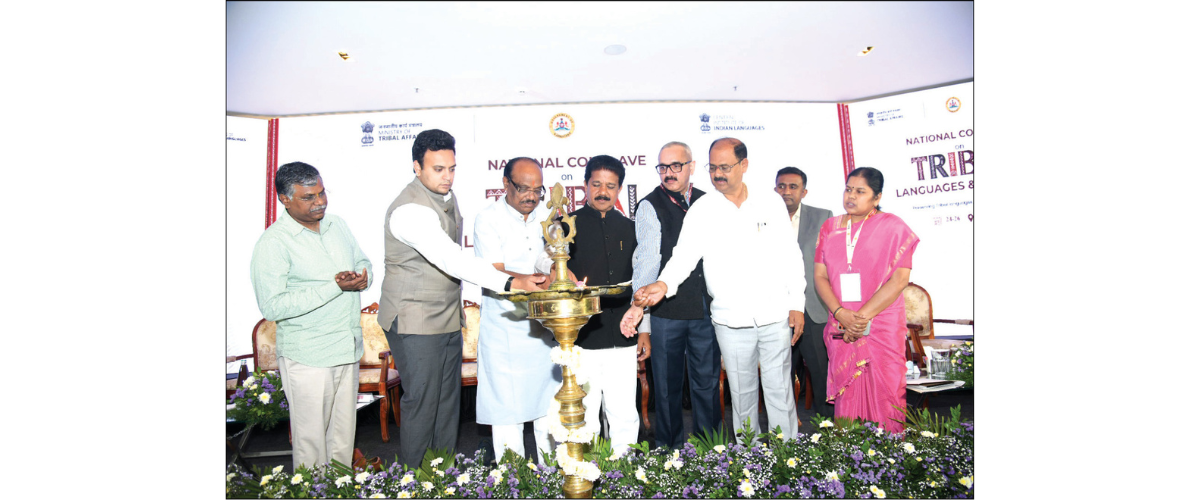
- The Ministry of Tribal Affairs has organised a three-day National Conclave on Tribal Languages and Museums in Mysuru, Karnataka.
- It was inaugurated by Union Minister of State for Tribal Affairs Durgadas Uikey.
- The conclave seeks to develop a national approach for:
- Documentation, preservation and revitalisation of tribal languages.
- Strengthening Tribal Museums and Tribal Freedom Fighter Museums (TFFMs).
- Expanding the use of digital technologies for tribal-language preservation and education.
- Major initiatives include the release of Karnataka Primers in tribal languages, an MoU between the Ministry of Tribal Affairs and the Central Institute of Indian Languages (CIIL), the launch of a tribal-welfare chatbot/TriBot and an upgrade of the Adi Vaani platform.
Tribal Language Preservation
- Several tribal languages and dialects are unwritten, under-represented in formal education and vulnerable to inter-generational language loss.
- Their decline can also result in loss of traditional knowledge relating to:
- Ecology and biodiversity.
- Traditional medicine.
- Agriculture.
- Oral histories, folklore and cultural practices.
- The conclave emphasises community-led language revitalisation, rather than documentation alone.
- Technical discussions cover:
- Automatic Speech Recognition (ASR).
- Text-to-Speech and Speech-to-Text.
- Machine Translation.
- Language corpus creation.
- Data protection and commercial use of linguistic datasets.
- Multilingual Education (MLE).
Adi Vaani
- Adi Vaani is an AI-powered translation and language-preservation platform of the Ministry of Tribal Affairs.
- It enables translation between tribal languages and languages such as Hindi and English, along with tools for language learning and digitisation.
- Its capabilities include:
- Text-to-Text translation.
- Text-to-Speech.
- Speech-to-Text.
- Speech-to-Speech translation.
- Optical Character Recognition (OCR) for digitising written material.
- Tribal dictionaries and primers.
- At the conclave, the platform is being expanded through:
- Addition of 5 new languages.
- Launch of an iOS application.
- Additional digital features.
- Adi Vaani is intended to improve tribal-language access to education, governance and digital services.
TriBot
- TriBot is the Ministry of Tribal Affairs' AI-enabled digital assistant.
- It provides information relating to:
- Government schemes.
- Scholarships.
- Eligibility requirements.
- Tribal welfare programmes.
- It complements broader efforts to reduce linguistic and information-access barriers for tribal communities.
Tribal Freedom Fighter Museums
- The initiative follows the policy emphasis on documenting the contribution of tribal communities to India's anti-colonial and freedom struggles.
- The Ministry of Tribal Affairs has sanctioned 11 Tribal Freedom Fighter Museums across 10 States.
- 4 museums have been inaugurated so far.
- The conclave is examining how such museums can function as living institutions of memory and identity, rather than merely repositories of artefacts.
- Proposed approaches include:
- Community participation in curation.
- Authentic representation of tribal freedom narratives.
- AR/VR, interactive kiosks and other digital technologies.
- Modern conservation and exhibition techniques.
- The Ministry has also indicated that establishment of a permanent Tribal Museum in Mysuru may be considered.
Central Institute of Indian Languages (CIIL)
- Location: Mysuru, Karnataka.
- Established: 1969.
- It functions as a subordinate office under the Department of Higher Education, Ministry of Education.
- Major functions include:
- Research on Indian languages.
- Language analysis and pedagogy.
- Language technology.
- Creation of linguistic content and corpora.
- Documentation and protection of minor, minority and tribal languages.
- An MoU between CIIL and the Ministry of Tribal Affairs forms part of the conclave's institutional push for tribal-language preservation.
Additional Info
- Article 29(1) of the Constitution
- Gives any section of Indian citizens having a distinct language, script or culture the right to conserve it.
- Article 342
- Deals with identification of Scheduled Tribes.
- The President specifies STs for a State/UT, while Parliament may subsequently include or exclude communities through law.
- Article 350A
- Requires States and local authorities to endeavour to provide adequate facilities for mother-tongue instruction at the primary stage for children belonging to linguistic minority groups.
- Tribal Research Institutes (TRIs)
- Work with State governments and the Ministry of Tribal Affairs on tribal research, documentation, training and preservation of cultural heritage.
- They are important institutional partners in documenting and revitalising tribal languages.
Sources
NITI Aayog Flags Major Skilling Gaps in India

What’s the News?
- NITI Aayog has released the report “Reimagining Skilling for Viksit Bharat@2047”, highlighting gaps between education, skills and employment in India.
- Around 8.7 crore youth aged 15–29 are classified as NEET — Not in Education, Employment or Training.
- Only 8.25% of graduates are employed in jobs aligned with their qualifications, indicating a significant education-employment mismatch.
- The report recommends shifting the skilling system from measuring enrolments and training numbers to employment, wage and career outcomes.
- It also calls for skilling systems to respond to changing labour-market requirements arising from AI, automation, green industries and emerging occupations.
Key Skilling Gaps
- India has formally trained over 7.67 crore people since 2014-15.
- Around ₹34,000 crore was allocated towards skilling-related expenditure across Central ministries in FY 2025-26.
- Despite this scale, major gaps include:
- Outdated curricula and weak industry alignment.
- Limited practical and work-based learning.
- Fragmented apprenticeship opportunities.
- High cost of additional skilling for low-income students.
- Limited flexibility for people who need to learn while earning.
- Fewer than 1 in 12 secondary schools currently offer vocational subjects.
- The report divides learners and workers into five segments:
- School students.
- Tertiary students.
- Formal and informal workers.
- NEET youth.
- Women.
- Together, these groups cover around 60 crore people.
Skilling in Schools
- The report proposes introducing General Employability and Entrepreneurship Skills (GEES) universally from Class 6 to Class 12.
- It recommends Kaushal Tracks from Class 9, providing structured vocational pathways based on local and national labour demand.
- Vocational subjects should receive equal weightage in Classes 10 and 12 board subject schemes.
- The approach seeks to integrate vocational education with mainstream schooling rather than treating skilling as a separate post-school activity.
Higher Education & Apprenticeships
- Higher education should move towards:
- Industry-aligned specialisations.
- Work-integrated degree and diploma programmes.
- Apprenticeships.
- Modular courses and micro-credentials.
- Earn-while-you-learn models.
- The report recommends increasing apprenticeship opportunities, particularly through MSME participation, and improving access through integrated digital platforms.
- Reskilling should focus on sectors such as green industries, electric vehicles and technology-driven occupations, while supporting workers affected by declining occupations.
Digital Skills Passport
- NITI Aayog proposes a Digital Skills Passport linked with APAAR ID.
- It would serve as a lifelong digital record of an individual's:
- Educational qualifications.
- Verified skills.
- Work experience.
- Micro-credentials.
- It could integrate existing platforms such as:
- Skill India Digital Hub (SIDH).
- Academic Bank of Credits (ABC).
- National Career Service (NCS).
- The system is intended to improve job matching, apprenticeships, recognition of skills and lifelong learning.
Outcome-Linked Financing
- The report recommends moving away from funding based mainly on enrolment and course completion.
- Funding should increasingly depend on outcomes such as:
- Verified job placements.
- Wage improvement.
- Sustained employment.
- Career progression.
- Proposed financing instruments include:
- Digital Skill Vouchers.
- Placement-linked loans.
- Skill Impact Bonds.
- This model seeks to make training providers more accountable for employment outcomes.
National Credit Framework-Based Mobility
- The National Credit Framework (NCrF) can enable movement between:
- Academic education.
- Vocational education.
- Skill training.
- Work-based learning.
- Recognition of Prior Learning (RPL) can convert skills and experience acquired through work into recognised credits.
- The objective is to allow learners to move between ITIs, universities, vocational programmes and employment without losing accumulated learning credits.
Additional Info
- NITI Aayog
- Full form: National Institution for Transforming India.
- It is the Government of India's apex public-policy think tank.
- It replaced the Planning Commission.
- Chairperson: Prime Minister of India.
- Promotes cooperative and competitive federalism and provides policy inputs to Central and State governments.
- NEET
- Means Not in Education, Employment or Training.
- The report's estimate of 8.7 crore NEET youth is based on the 78th Round of the National Sample Survey.
- It covers people aged 15–29 years who are outside education, employment and training, including unemployed persons.
- National Education Policy (NEP) 2020
- Supports integration of vocational education with mainstream education.
- Envisages greater exposure to vocational learning beginning from the school level.
Sources
SEBI Introduces IT Resilience Index for Market Infrastructure Institutions

What’s the News?
- The Securities and Exchange Board of India (SEBI) has introduced an IT Resilience Index (ITRI) framework for Market Infrastructure Institutions (MIIs).
- The index will assess the robustness and resilience of critical IT systems supporting India's securities market.
- It will evaluate MIIs across 9 parameters with a total weightage of 100, covering areas such as availability, cybersecurity, business continuity and system reliability.
- MIIs must also establish an Early Warning System (EWS) and real-time monitoring mechanisms to identify deterioration or disruption in technology services.
IT Resilience Index (ITRI)
- ITRI is a system-driven framework for periodically measuring the health and resilience of critical IT systems operated by MIIs.
- It covers:
- Critical systems specified under SEBI's regulatory framework.
- Other IT systems feeding into or connected with these critical systems.
- Its objectives are to:
- Identify emerging technological weaknesses at an early stage.
- Ensure uninterrupted delivery of securities-market services.
- Strengthen cyber and operational resilience.
- Enable timely corrective measures.
- Computation is intended to be automatic and non-discretionary, using data directly from IT systems.
- Manual data retrieval is permitted only in exceptional cases after prior discussion with the Standing Committee on Technology (SCOT).
9 Parameters & Weightage
| Parameter | Weightage |
|---|---|
| Availability | 20 |
| Security | 20 |
| Integrity | 10 |
| Governance | 10 |
| Reliability & Monitoring | 10 |
| Business Continuity | 10 |
| Modularity & Flexibility | 10 |
| Scalability | 5 |
| Others, including Incident Handling | 5 |
| Total | 100 |
- Availability and Security receive the highest weightage at 20 each.
- The framework therefore gives particular importance to keeping market systems continuously operational and protected against cyber threats.
Monitoring & Early Warning System
- MIIs must develop an Early Warning System capable of detecting deterioration in ITRI parameters that could cause:
- Performance issues.
- System slowness.
- Service disruptions.
- They must establish consolidated dashboards providing continuous visibility into:
- System and application performance.
- Service delivery to market participants.
- Deviations and anomalies.
- Standard Operating Procedures (SOPs) must be developed for identifying and responding to disruptions.
Assessment & Implementation
- ITRI will be computed half-yearly, within 60 days from the end of each half-year.
- MIIs must present:
- Comparative analysis of two consecutive half-years.
- Corrective actions taken or proposed.
- Findings to their SCOT and Governing Board.
- The Industry Standards Forum (ISF) of MIIs will finalise:
- Sub-parameters.
- Measurement criteria.
- Baseline parameters.
- Acceptable threshold scores.
- System-driven scoring methodology.
- Key implementation milestones:
- 30 November 2026: ISF to finalise sub-parameters and measurement criteria.
- 31 January 2027: Detailed SOPs, after SCOT review, to be submitted to SEBI.
- 28 February 2027: ITRI framework, EWS and real-time service monitoring to become operational.
- First ITRI computation will cover the half-year ending 31 March 2027.
- MIIs have already implemented a beta version of the ITRI framework.
Market Infrastructure Institutions (MIIs)
- MIIs provide the essential infrastructure required for the functioning of the securities market.
- Under the framework, they include:
- Stock Exchanges – provide platforms for trading securities.
- Clearing Corporations – facilitate clearing and settlement of trades and manage counterparty risk.
- Depositories – hold securities in electronic form and facilitate their transfer.
- The circular applies to stock exchanges, clearing corporations and depositories, with AMC Repo Clearing Ltd. excluded from its coverage.
- Disruption of an MII's technology systems can affect trading, clearing, settlement and investor confidence across the financial market.
Additional Info
- SEBI
- Established as a non-statutory body in 1988 and given statutory status under the SEBI Act, 1992.
- It is the principal regulator of India's securities market.
- Its broad objectives are:
- Protecting investors' interests.
- Promoting development of the securities market.
- Regulating the securities market.
- The ITRI circular has been issued under Section 11(1) of the SEBI Act, 1992.
- Standing Committee on Technology (SCOT)
- Provides technology-related oversight within MIIs.
- Under ITRI, it will review performance trends, exceptions involving manual computation and proposed corrective measures.
- Industry Standards Forum (ISF)
- A SEBI-constituted industry mechanism for developing common implementation standards for MIIs.
- Under ITRI, it is responsible for creating uniform measurement and scoring standards to ensure comparability across MIIs.
Sources
ICAR Registers 16 New Indigenous Livestock and Dog Breeds
What’s the News?
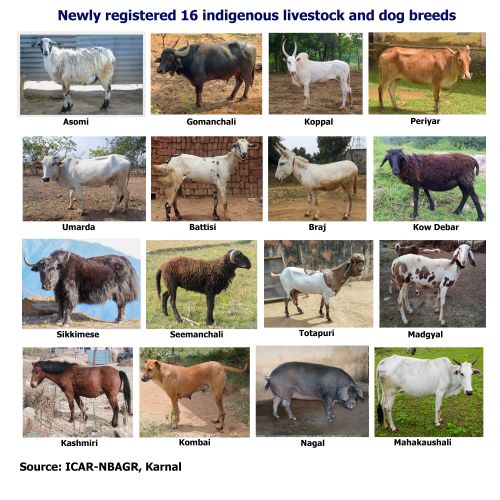
- The Indian Council of Agricultural Research (ICAR) has recognised 16 new indigenous livestock and dog breeds, strengthening documentation and conservation of India's animal genetic resources.
- The breeds represent 9 species and originate from 13 States and one Union Territory.
- With these additions, the total number of breeds registered by ICAR-National Bureau of Animal Genetic Resources (ICAR-NBAGR) has increased to 262, comprising:
- 258 indigenous breeds.
- 4 synthetic breeds.
- Each newly registered breed has been assigned a unique accession number by ICAR-NBAGR.
16 Newly Registered Breeds
| Species | Breed | Home Tract |
|---|---|---|
| Cattle | Koppal | Karnataka |
| Mahakaushali | Madhya Pradesh | |
| Periyar | Kerala | |
| Umarda | Maharashtra | |
| Buffalo | Gomanchali | Goa |
| Goat | Battisi | Rajasthan & Uttar Pradesh |
| Totapuri | Rajasthan | |
| Sheep | Asomi | Assam |
| Kow Debar | Uttarakhand | |
| Madgyal | Maharashtra & Karnataka | |
| Seemanchali | Bihar | |
| Donkey | Braj | Uttar Pradesh |
| Horse/Pony | Kashmiri | Jammu & Kashmir |
| Pig | Nagal | Nagaland |
| Yak | Sikkimese | Sikkim |
| Dog | Kombai | Tamil Nadu |
- Cattle and sheep account for the largest additions, with 4 breeds each, followed by 2 goat breeds and one breed each of the remaining species.
Why Register Indigenous Breeds?
- Breed registration involves the scientific identification, characterisation and official documentation of distinct animal populations.
- It helps reduce the proportion of non-descript livestock populations by bringing scientifically identified breeds into the national database.
- Indigenous breeds are important because they often possess traits suited to local agro-climatic conditions, including:
- Heat and climate resilience.
- Adaptation to local diseases and environmental stresses.
- Ability to perform under low-input production systems.
- Support for rural livelihoods and sustainable livestock farming.
- Formal recognition also facilitates targeted conservation, breeding and sustainable utilisation programmes.
ICAR-NBAGR
- ICAR-National Bureau of Animal Genetic Resources (NBAGR) is located at Karnal, Haryana.
- It is the nodal institute for registration of livestock and poultry breeds in India.
- Its major functions include:
- Identification and characterisation of indigenous animal genetic resources.
- Registration and documentation of recognised breeds.
- Conservation of livestock biodiversity.
- Maintenance of information on India's animal genetic resources.
- The Breed Registration Committee (BRC) examines breed proposals, while ICAR-NBAGR assigns unique accession numbers to approved breeds.
Additional Info
- Indian Council of Agricultural Research (ICAR)
- Apex national organisation for coordinating, guiding and managing agricultural research and education in India.
- Functions under the Department of Agricultural Research and Education (DARE), Ministry of Agriculture & Farmers Welfare.
- Animal Genetic Resources
- Include animal breeds and populations possessing genetic characteristics of actual or potential value for agriculture and food production.
- Indigenous genetic resources are important for maintaining genetic diversity, particularly as climate change increases pressure on livestock productivity.
- Breed Registration
- Provides a recognised identity to locally adapted animal populations.
- Supports systematic conservation and prevents valuable genetic traits from being lost through indiscriminate crossbreeding or decline of local populations.
- Recognises the contribution of livestock keepers, breeders, State Animal Husbandry Departments, universities and research institutions in conserving indigenous breeds.
Sources
India Celebrates Third National Space Day

What’s the News?
- India celebrated its third National Space Day on 23 August 2026, commemorating the successful soft landing of Chandrayaan-3 on the Moon.
- Theme 2026: “Towards Viksit Bharat: Innovating, Collaborating and Aspiring to Global Space Leadership.”
- The national-level celebration was held at the Space Applications Centre (SAC), Ahmedabad, a major centre of ISRO.
- The observance highlighted India's achievements in lunar exploration, human spaceflight preparations, private-sector participation and plans for an indigenous space station.
National Space Day
- Observed: 23 August every year.
- It commemorates the landing of the Vikram lander of Chandrayaan-3 on 23 August 2023.
- The first National Space Day was celebrated in 2024.
- The observance aims to:
- Celebrate India's achievements in space science and technology.
- Promote public awareness of space applications.
- Encourage students and youth to pursue STEM and space-related fields.
Chandrayaan-3
- Chandrayaan-3 was India's third lunar mission and a follow-on mission to Chandrayaan-2.
- Its major components were:
- Propulsion Module.
- Vikram Lander.
- Pragyan Rover.
- Its objectives included demonstrating:
- Safe and soft landing on the lunar surface.
- Rover mobility on the Moon.
- In-situ scientific experiments.
- India became:
- The fourth country to achieve a successful soft landing on the Moon.
- The first country to land near the Moon's south polar region.
- The Chandrayaan-3 landing site was named Shiv Shakti Point.
India’s Future Space Programme
- Gaganyaan
- India's human spaceflight programme.
- Designed to demonstrate India's capability to send astronauts to Low Earth Orbit (LEO) and return them safely to Earth.
- Preparations include uncrewed missions and testing of human-rated systems.
- Chandrayaan-4
- Planned as a lunar sample-return mission.
- It is intended to demonstrate technologies for collecting lunar samples, launching them from the Moon and returning them to Earth.
- Chandrayaan-5 / LUPEX
- A proposed ISRO-JAXA Lunar Polar Exploration Mission.
- Intended to study water and other volatile substances in the lunar polar region.
- Bharatiya Antariksh Station (BAS)
- India's proposed indigenous space station.
- The Government has approved development of its first module.
- India aims to establish the space station by 2035.
Expanding Private Space Ecosystem
- Space-sector reforms introduced in 2020 opened the sector to greater private participation.
- India now has more than 440 space start-ups.
- IN-SPACe facilitates and promotes participation of private entities in India's space sector.
- The National Space Day theme emphasises innovation, collaboration and global leadership, reflecting the growing role of public-private partnerships in India's space ambitions.
Additional Info
- ISRO
- Full form: Indian Space Research Organisation.
- Functions under the Department of Space.
- Headquarters: Bengaluru, Karnataka.
- Established in 1969.
- Its predecessor was the Indian National Committee for Space Research (INCOSPAR).
- Space Applications Centre (SAC)
- Located in Ahmedabad, Gujarat.
- One of ISRO's major research and development centres.
- Works on space-borne and air-borne instruments and applications of space technology.
- IN-SPACe
- Full form: Indian National Space Promotion and Authorisation Centre.
- Acts as the single-window agency for promoting, enabling and authorising private-sector space activities in India.
- Headquarters: Ahmedabad, Gujarat.
Sources
August 2026
31 August 202629 August 202627 August 202626 August 202625 August 202624 August 202622 August 202621 August 202620 August 202619 August 202618 August 202617 August 202614 August 202613 August 202612 August 202611 August 202610 August 202608 August 202607 August 202606 August 202605 August 202604 August 202603 August 202601 August 2026
Archive
November 2026
- 28 November 2026
- 27 November 2026
- 26 November 2026
- 25 November 2026
- 24 November 2026
- 23 November 2026
- 21 November 2026
- 20 November 2026
- 19 November 2026
- 18 November 2026
- 17 November 2026
- 16 November 2026
- 14 November 2026
- 13 November 2026
- 12 November 2026
- 11 November 2026
- 10 November 2026
- 09 November 2026
- 06 November 2026
- 05 November 2026
- 04 November 2026
- 03 November 2026
- 02 November 2026
October 2026
- 31 October 2026
- 30 October 2026
- 29 October 2026
- 28 October 2026
- 27 October 2026
- 26 October 2026
- 24 October 2026
- 23 October 2026
- 22 October 2026
- 21 October 2026
- 20 October 2026
- 19 October 2026
- 17 October 2026
- 16 October 2026
- 15 October 2026
- 14 October 2026
- 13 October 2026
- 12 October 2026
- 10 October 2026
- 09 October 2026
- 08 October 2026
- 07 October 2026
- 06 October 2026
- 05 October 2026
- 03 October 2026
- 02 October 2026
- 01 October 2026
September 2026
- 30 September 2026
- 29 September 2026
- 28 September 2026
- 26 September 2026
- 25 September 2026
- 24 September 2026
- 23 September 2026
- 22 September 2026
- 21 September 2026
- 19 September 2026
- 18 September 2026
- 17 September 2026
- 16 September 2026
- 15 September 2026
- 12 September 2026
- 11 September 2026
- 10 September 2026
- 09 September 2026
- 08 September 2026
- 07 September 2026
- 05 September 2026
- 04 September 2026
- 03 September 2026
- 02 September 2026
- 01 September 2026
August 2026
- 31 August 2026
- 29 August 2026
- 27 August 2026
- 26 August 2026
- 25 August 2026
- 24 August 2026
- 22 August 2026
- 21 August 2026
- 20 August 2026
- 19 August 2026
- 18 August 2026
- 17 August 2026
- 14 August 2026
- 13 August 2026
- 12 August 2026
- 11 August 2026
- 10 August 2026
- 08 August 2026
- 07 August 2026
- 06 August 2026
- 05 August 2026
- 04 August 2026
- 03 August 2026
- 01 August 2026
July 2026
- 31 July 2026
- 30 July 2026
- 29 July 2026
- 28 July 2026
- 27 July 2026
- 25 July 2026
- 23 July 2026
- 22 July 2026
- 21 July 2026
- 20 July 2026
- 18 July 2026
- 17 July 2026
- 15 July 2026
- 14 July 2026
- 13 July 2026
- 11 July 2026
- 10 July 2026
- 09 July 2026
- 08 July 2026
- 07 July 2026
- 06 July 2026
- 04 July 2026
- 03 July 2026
- 02 July 2026
- 01 July 2026
June 2026
May 2026
April 2026
March 2026
- 31 March 2026
- 30 March 2026
- 28 March 2026
- 27 March 2026
- 26 March 2026
- 25 March 2026
- 24 March 2026
- 23 March 2026
- 21 March 2026
- 20 March 2026
- 19 March 2026
- 18 March 2026
- 17 March 2026
- 16 March 2026
- 14 March 2026
- 13 March 2026
- 12 March 2026
- 11 March 2026
- 10 March 2026
- 09 March 2026
- 07 March 2026
- 06 March 2026
- 05 March 2026
- 03 March 2026
- 02 March 2026
February 2026
- 28 February 2026
- 27 February 2026
- 26 February 2026
- 25 February 2026
- 24 February 2026
- 23 February 2026
- 21 February 2026
- 20 February 2026
- 19 February 2026
- 18 February 2026
- 17 February 2026
- 16 February 2026
- 13 February 2026
- 12 February 2026
- 11 February 2026
- 10 February 2026
- 09 February 2026
- 07 February 2026
- 06 February 2026
- 05 February 2026
- 04 February 2026
- 03 February 2026
- 02 February 2026
January 2026
- 31 January 2026
- 30 January 2026
- 29 January 2026
- 28 January 2026
- 27 January 2026
- 26 January 2026
- 24 January 2026
- 23 January 2026
- 22 January 2026
- 21 January 2026
- 20 January 2026
- 19 January 2026
- 16 January 2026
- 15 January 2026
- 14 January 2026
- 13 January 2026
- 12 January 2026
- 10 January 2026
- 09 January 2026
- 08 January 2026
- 07 January 2026
- 06 January 2026
- 05 January 2026
- 03 January 2026
- 02 January 2026
- 01 January 2026
December 2025
- 31 December 2025
- 30 December 2025
- 29 December 2025
- 27 December 2025
- 26 December 2025
- 24 December 2025
- 23 December 2025
- 22 December 2025
- 20 December 2025
- 19 December 2025
- 18 December 2025
- 17 December 2025
- 16 December 2025
- 15 December 2025
- 13 December 2025
- 12 December 2025
- 11 December 2025
- 10 December 2025
- 09 December 2025
- 08 December 2025
- 05 December 2025
- 04 December 2025
- 03 December 2025
- 02 December 2025
November 2025
- 29 November 2025
- 28 November 2025
- 27 November 2025
- 26 November 2025
- 25 November 2025
- 24 November 2025
- 22 November 2025
- 21 November 2025
- 20 November 2025
- 19 November 2025
- 18 November 2025
- 17 November 2025
- 15 November 2025
- 14 November 2025
- 13 November 2025
- 12 November 2025
- 11 November 2025
- 10 November 2025
- 08 November 2025
- 07 November 2025
- 06 November 2025
- 05 November 2025
- 04 November 2025
- 03 November 2025
- 01 November 2025
October 2025
- 31 October 2025
- 30 October 2025
- 29 October 2025
- 28 October 2025
- 27 October 2025
- 25 October 2025
- 24 October 2025
- 23 October 2025
- 22 October 2025
- 21 October 2025
- 20 October 2025
- 18 October 2025
- 17 October 2025
- 16 October 2025
- 15 October 2025
- 14 October 2025
- 13 October 2025
- 11 October 2025
- 10 October 2025
- 09 October 2025
- 08 October 2025
- 07 October 2025
- 06 October 2025
- 04 October 2025
- 03 October 2025
- 02 October 2025
- 01 October 2025
September 2025
- 30 September 2025
- 29 September 2025
- 27 September 2025
- 26 September 2025
- 25 September 2025
- 24 September 2025
- 23 September 2025
- 22 September 2025
- 20 September 2025
- 19 September 2025
- 18 September 2025
- 17 September 2025
- 16 September 2025
- 15 September 2025
- 13 September 2025
- 12 September 2025
- 11 September 2025
- 10 September 2025
- 09 September 2025
- 08 September 2025
- 06 September 2025
- 05 September 2025
- 04 September 2025
- 03 September 2025
- 02 September 2025
- 01 September 2025
August 2025
- 30 August 2025
- 29 August 2025
- 28 August 2025
- 27 August 2025
- 26 August 2025
- 25 August 2025
- 23 August 2025
- 22 August 2025
- 21 August 2025
- 20 August 2025
- 19 August 2025
- 18 August 2025
- 16 August 2025
- 14 August 2025
- 13 August 2025
- 12 August 2025
- 11 August 2025
- 08 August 2025
- 07 August 2025
- 06 August 2025
- 05 August 2025
- 04 August 2025
- 02 August 2025
- 01 August 2025
July 2025
- 31 July 2025
- 30 July 2025
- 29 July 2025
- 28 July 2025
- 26 July 2025
- 25 July 2025
- 24 July 2025
- 23 July 2025
- 22 July 2025
- 21 July 2025
- 19 July 2025
- 18 July 2025
- 17 July 2025
- 16 July 2025
- 15 July 2025
- 12 July 2025
- 11 July 2025
- 10 July 2025
- 09 July 2025
- 07 July 2025
- 05 July 2025
- 04 July 2025
- 03 July 2025
- 02 July 2025
- 01 July 2025
June 2025
- 30 June 2025
- 28 June 2025
- 27 June 2025
- 26 June 2025
- 25 June 2025
- 24 June 2025
- 23 June 2025
- 21 June 2025
- 20 June 2025
- 19 June 2025
- 18 June 2025
- 17 June 2025
- 16 June 2025
- 14 June 2025
- 13 June 2025
- 12 June 2025
- 11 June 2025
- 10 June 2025
- 09 June 2025
- 07 June 2025
- 06 June 2025
- 05 June 2025
- 04 June 2025
- 03 June 2025
- 02 June 2025
May 2025
April 2025
- 30 April 2025
- 29 April 2025
- 28 April 2025
- 26 April 2025
- 25 April 2025
- 24 April 2025
- 23 April 2025
- 22 April 2025
- 21 April 2025
- 19 April 2025
- 18 April 2025
- 17 April 2025
- 16 April 2025
- 15 April 2025
- 14 April 2025
- 12 April 2025
- 11 April 2025
- 10 April 2025
- 09 April 2025
- 08 April 2025
- 07 April 2025
- 05 April 2025
- 04 April 2025
- 03 April 2025
- 02 April 2025
- 01 April 2025
March 2025
- 31 March 2025
- 29 March 2025
- 28 March 2025
- 27 March 2025
- 26 March 2025
- 25 March 2025
- 24 March 2025
- 22 March 2025
- 21 March 2025
- 20 March 2025
- 19 March 2025
- 18 March 2025
- 17 March 2025
- 15 March 2025
- 13 March 2025
- 12 March 2025
- 11 March 2025
- 10 March 2025
- 08 March 2025
- 07 March 2025
- 06 March 2025
- 05 March 2025
- 04 March 2025
- 03 March 2025
- 01 March 2025
February 2025
- 28 February 2025
- 27 February 2025
- 26 February 2025
- 25 February 2025
- 24 February 2025
- 22 February 2025
- 21 February 2025
- 20 February 2025
- 19 February 2025
- 18 February 2025
- 17 February 2025
- 15 February 2025
- 14 February 2025
- 13 February 2025
- 12 February 2025
- 11 February 2025
- 10 February 2025
- 08 February 2025
- 07 February 2025
- 06 February 2025
- 05 February 2025
- 04 February 2025
- 03 February 2025
- 01 February 2025
January 2025
- 31 January 2025
- 30 January 2025
- 29 January 2025
- 28 January 2025
- 27 January 2025
- 25 January 2025
- 24 January 2025
- 23 January 2025
- 22 January 2025
- 21 January 2025
- 20 January 2025
- 18 January 2025
- 17 January 2025
- 16 January 2025
- 15 January 2025
- 14 January 2025
- 13 January 2025
- 11 January 2025
- 10 January 2025
- 09 January 2025
- 08 January 2025
- 07 January 2025
- 06 January 2025
- 04 January 2025
- 03 January 2025
- 02 January 2025
- 01 January 2025