
Current Affairs
Stay updated with the latest national and international events.
25 September 2025
World Pharmacists Day 2025

What’s the News?
- The International Pharmaceutical Federation (FIP) announced the theme for World Pharmacists Day 2025, observed on September 25, as “Think Health, Think Pharmacist”.
- The campaign aims to celebrate the pharmacy profession and advocate for its full integration into global health strategies, emphasizing pharmacists' role in improving health literacy, delivering vaccinations, and ensuring safe medicine use.
World Pharmacists Day Overview
- Establishment: Adopted by the FIP Council in 2009, with the date marking the federation's founding in 1912.
- Objective: To encourage activities that promote the role of the pharmacist in improving health worldwide and to close the World Pharmacy Week (19-25 September).
- Significance: Highlights the indispensable role of pharmacists in strengthening health systems, particularly amid rising healthcare demands and workforce shortages.
Additional Info
- History of the Day:
- Establishment: The day was designated in 2009 by the International Pharmaceutical Federation (FIP) Council at the World Congress of Pharmacy and Pharmaceutical Sciences in Istanbul, Turkey.
- Date Significance: September 25 was chosen as it marks the anniversary of the founding of FIP in 1912.
- Regulatory Body in India:
- Pharmacy Council of India (PCI):
- It is a statutory body constituted under the Pharmacy Act, 1948.
- Its primary mandate is to regulate the profession and practice of pharmacy across India.
- Key functions include prescribing minimum educational standards, approving pharmacy courses and institutions, and maintaining a central register of pharmacists.
- Pharmacy Council of India (PCI):
- Related Government Initiative:
- Pradhan Mantri Bhartiya Janaushadhi Pariyojana (PMBJP):
- A campaign launched by the Department of Pharmaceuticals, Ministry of Chemicals & Fertilizers.
- Aims to provide quality generic medicines at affordable prices through dedicated outlets known as Janaushadhi Kendras.
- Pharmacists are essential to the functioning of these Kendras, ensuring the correct dispensing of medicines and advising patients, thereby furthering the goal of affordable healthcare for all.
- Pradhan Mantri Bhartiya Janaushadhi Pariyojana (PMBJP):
Sources
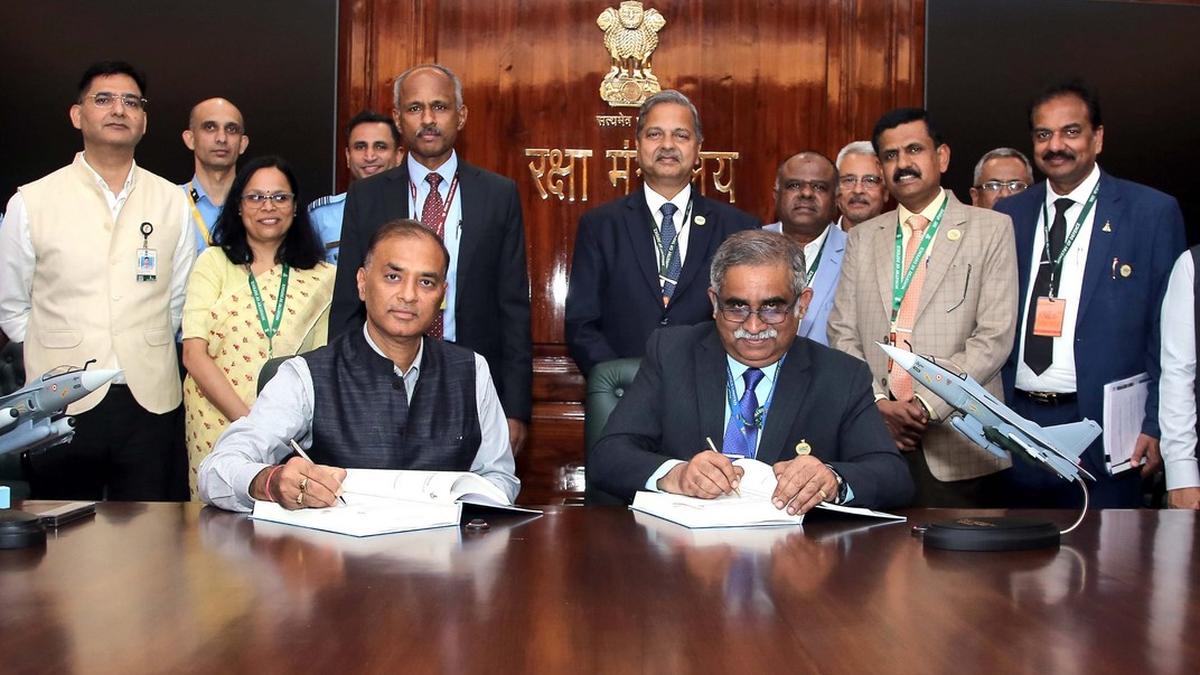
Defence Ministry Boosts Aatmanirbharta with Major LCA Deal
What’s the News?
- The Ministry of Defence has signed a contract with Hindustan Aeronautics Limited (HAL) for the procurement of 97 Light Combat Aircraft (LCA) Mark-1A for the Indian Air Force (IAF).
- The deal is worth over ₹62,370 crore and includes 68 single-seat fighter jets and 29 twin-seat aircraft, along with associated equipment.
- Deliveries will begin in 2027-28 and be completed over a period of six years.
Key Features of the Tejas Mark-1A
- Indigenous Content: Over 64% of the aircraft's components are indigenously manufactured, with 67 additional items incorporated compared to the 2021 contract.
- Advanced Systems: The aircraft will feature advanced systems such as:
- UTTAM Active Electronically Scanned Array (AESA) Radar
- Swayam Raksha Kavach (Self-Protection Suite)
- Indigenous Control Surface Actuators
Additional Info
- LCA Tejas:
- An indigenously designed, single-engine, multi-role, 4.5-generation tactical fighter aircraft.
- It is the lightest and smallest in its class of contemporary supersonic combat aircraft.
- Designed by: Aeronautical Development Agency (ADA) in collaboration with the Aircraft Research and Design Centre (ARDC) of HAL.
- Manufactured by: Hindustan Aeronautics Limited (HAL).
- Variants of LCA Tejas:
- Tejas Mk1: The initial operational version for the IAF.
- Tejas Mk1A: An upgraded version with advanced features, including:
- Active Electronically Scanned Array (AESA) Radar
- An advanced Electronic Warfare (EW) suite
- Beyond Visual Range (BVR) missile capabilities
- Network warfare systems like Software Defined Radio (SDR)
- Tejas Mk2: A planned medium-weight fighter, which will be a more capable and heavier version of the LCA.
Sources
India Tests Agni-Prime Missile from Rail Mobile Launcher

What’s the News?
- India has successfully conducted the first flight test of the new-generation ballistic missile, Agni-Prime (Agni-P), from a rail-based mobile launcher system.
- The test was carried out by the Defence Research and Development Organisation (DRDO) from Dr. APJ Abdul Kalam Island off the coast of Odisha.
- This successful launch places India among a select group of nations possessing the advanced technological capability of launching missiles from rail-based platforms.
Key Features & Strategic Significance
- Agni-Prime is a two-stage, canisterized, solid-propellant missile with a strike range between 1,000 and 2,000 kilometers.
- Technological Advancements:
- Canister Launch: Being canisterized allows the missile to be stored for extended periods, transported easily via road or rail, and launched quickly, significantly reducing reaction time.
- Rail Mobile Launcher: This system provides greater operational flexibility and survivability. The ability to move the missile launch system along the country's extensive rail network makes it harder for adversaries to track and target.
- Guidance System: It is equipped with a dual redundant navigation and guidance system, ensuring high accuracy.
- This capability enhances India's strategic deterrence by adding a new layer of mobility and stealth to its missile arsenal.
Additional Info
- Integrated Guided Missile Development Programme (IGMDP):
- Conceived by Dr. A.P.J. Abdul Kalam, the programme aimed to make India self-sufficient in missile technology.
- It led to the development of five key missile systems, often remembered by the acronym PATNA:
- Prithvi: Short-range surface-to-surface ballistic missile.
- Agni: Series of surface-to-surface ballistic missiles with varying ranges.
- Trishul: Short-range surface-to-air missile.
- Nag: Third-generation anti-tank missile.
- Akash: Medium-range surface-to-air missile.
- The Agni Missile Series:
- The Agni series forms the backbone of India’s nuclear delivery capability.
- Agni-I: Short-range ballistic missile (700–1,200 km).
- Agni-II: Medium-range ballistic missile (2,000–3,500 km).
- Agni-III & Agni-IV: Intermediate-range ballistic missiles (IRBM) with ranges of 3,500 km and 4,000 km respectively.
- Agni-V: Intercontinental ballistic missile (ICBM) with a range exceeding 5,000 km.
Sources
Cabinet Approves Scheme to Add 10,023 MBBS and PG Seats by 2028-29

What’s the News?
- The Union Cabinet, chaired by Prime Minister Narendra Modi, has approved the third phase of the centrally sponsored scheme to add 5,023 MBBS seats and 5,000 PG seats in existing government medical colleges and institutes.
- The initiative, costing ₹15,034 crore over the next three years, aims to significantly augment undergraduate medical capacity and increase the availability of specialist doctors.
- The total financial implications are ₹15,034 crore for the period from 2025-26 to 2028-29, with the central share being ₹10,303 crore and the state share being ₹4,731 crore.
Key Features of the Scheme
- MBBS Seats:
- Addition of 5,023 MBBS seats in existing government medical colleges.
- This will enhance the quality of medical education and training to meet global standards.
- PG Seats:
- Creation of 5,000 PG seats to increase the availability of specialist doctors.
- Introduction of new specialties across government medical institutions.
- Financial Allocation:
- Central share: ₹10,303 crore
- State share: ₹4,731 crore
Background
- Previous Phases:
- First Phase: Added 4,977 MBBS seats in 83 colleges at a cost of ₹5,972 crore and 4,058 PG seats in 72 colleges for ₹1,498 crore.
- Second Phase: Added 4,000 MBBS seats across 65 colleges with the Centre allocating ₹4,478 crore for the expansion.
- Current Medical Seat Availability:
- India currently has around 1.2 lakh MBBS seats and 74,306 PG medical seats.
- This marks a near doubling of capacity since 2014, when there were 51,328 MBBS seats and 31,185 PG seats.
- Challenges Addressed:
- Faculty Shortage: The National Medical Commission (NMC) has taken steps to curb the problem of ghost faculty, including online Aadhaar-based biometric attendance and live video feeds from colleges.
- Regulation of Fees: Efforts to regulate fees in private medical colleges to make medical education more affordable.
Sources
World Para Athletics Championships 2025 in New Delhi

What’s the News?
- India is hosting the 12th World Para Athletics Championships (IndianOil New Delhi 2025) at Jawaharlal Nehru Stadium, Delhi from 27 September to 5 October 2025.
- The event features 186 medal events (101 men, 84 women, 1 mixed)
- Over 2,200 para-athletes from 100+ countries are expected to participate.
- India has sent its largest ever contingent, with noted athletes like Sumit Antil, Preethi Pal, Dharambir Nain, and Deepthi Jeevanji as medal prospects.
- The stadium has been upgraded including a new Mondo track, enhanced accessibility (ramps, elevators), renovated seating and facilities.
Highlights of the Event
-
Indian Participation:
- 73 Indian para athletes are representing the host nation.
- Key medal hopefuls include:
- Sumit Antil: Current world record holder in javelin throw and a two-time Paralympic gold medallist.
- Dharambir Nain: Defending Paralympic champion in club throw and flag-bearer for India at the opening ceremony.
- Praveen Kumar: Two-time Paralympic medallist, including a gold medal at the Paris Paralympics.
- Preethi Pal: Won two bronze medals at the Paris Paralympics and the 2024 Kobe World Championships.
-
Global Stars:
- Athanasios Ghavelas (Greece): Two-time Paralympic champion in the men's 100m T11 and a world title holder.
- Catherine Debrunner (Switzerland): Five-time Paralympic gold medalist and eight-time World Championships medalist.
- Ezra Frech (USA): Gold medalist in the men's high jump T63 and a two-time World Championship medallist.
- Raoua Tlili (Tunisia): Eleven-time World Championships gold medalist and eight-time Paralympic gold medalist.
- Xiaoyan Wen (China): Four-time Paralympic gold medalist and eight-time World Championships gold medalist.
- Markus Rehm (Germany): Five-time Paralympic champion in long jump and world record holder.
-
Classification System:
- Para athletes are classified based on their physical, intellectual, or vision impairments.
- Track and jump events are denoted by 'T', while field events are denoted by 'F'.
- Categories include:
- T/F11-13: Vision impairment
- T/F20: Intellectual impairment
- T/F31-38: Coordination impairments, including wheelchair events
- T/F40-41: Short stature
- T/F42-44: Lower limb impairments without prosthesis
- T/F45-47 and 51-58: Upper limb impairments
- T/F61-64: Lower limb impairments with prosthesis
- T71-72: Coordination impairments in frame running events
Historical Context
- Previous Championships:
- The last edition was held in Kobe, Japan in 2024, where India won 17 medals, including six golds.
- China has dominated the medal table in recent years, winning 87 medals (including 33 golds) at the 2024 Kobe Championships.
- Indian Performance:
- At the Paris Paralympics, Indian para athletes won 29 medals, with 17 coming from track and field events.
- The country's performance in para athletics has been steadily improving, with a growing number of athletes achieving international recognition.
Additional Info
- World Para Athletics:
- It is the international governing body for para-athletics and operates under the umbrella of the International Paralympic Committee (IPC).
- It is responsible for organizing the World Para Athletics Championships and other major international competitions.
- Paralympic Committee of India (PCI):
- The PCI is the national body for the promotion and development of para-sports in India.
- It is recognized by the Ministry of Youth Affairs and Sports and is responsible for selecting athletes to represent India at the Paralympic Games and other international events.
Sources
Production Gap Report 2025: Fossil Fuel Plans Exceed Climate Limits

What’s the News?
- The Production Gap Report 2025 (PGR), released on September 22, 2025, reveals that global fossil fuel production plans significantly exceed the limits set by the Paris Agreement.
- The report, compiled by leading research institutes including the Stockholm Environment Institute (SEI), Climate Analytics, and International Institute for Sustainable Development (IISD), and backed by the UN, warns that planned fossil fuel production in 2030 will exceed levels consistent with limiting warming to 1.5°C by more than 120% and to 2°C by 77%.
Key Findings
- Coal, Oil, and Gas on the Rise:
- Coal: Global output in 2030 is projected to be 500% higher than the median 1.5°C pathway and 330% above the 2°C benchmark.
- Oil: Planned 2030 production exceeds Paris-aligned limits by 31%.
- Gas: Planned 2030 production exceeds Paris-aligned limits by 92%.
- Countries Ramping Up Extraction:
- China: Continues to back slower coal declines.
- United States: Plans higher levels of coal, oil, and gas production.
- Saudi Arabia: Projects significant increases in oil production.
- Brazil: Projects a 47% jump in oil output by 2030.
- Nigeria: Doubled its 2030 oil target.
- Fiscal Costs:
- Government support for fossil fuels remains near record highs, despite international pledges to phase out inefficient subsidies.
Additional Info
- Production Gap Report:
- It is a series of assessments that tracks the discrepancy between governments’ planned and projected production of fossil fuels and the global production levels consistent with the Paris Agreement goals.
- It complements the UNEP’s Emissions Gap Report, which tracks the gap between national emissions reduction pledges and the targets required to limit warming.
- The Paris Agreement:
- An international treaty on climate change, adopted in 2015.
- Its central aim is to hold the increase in the global average temperature to well below 2°C above pre-industrial levels and to pursue efforts to limit the temperature increase to 1.5°C.
- It works on a cycle where countries submit their climate action plans, known as Nationally Determined Contributions (NDCs).
- India’s Climate Commitments (Panchamrit):
- At COP26, India announced its five-fold strategy, the 'Panchamrit', to tackle climate change. Key commitments include:
- Reaching a non-fossil energy capacity of 500 GW by 2030.
- Fulfilling 50% of its energy requirements from renewable energy by 2030.
- Reducing the carbon intensity of its economy by 45% by 2030, over 2005 levels.
- Achieving the target of Net Zero emissions by 2070.
- At COP26, India announced its five-fold strategy, the 'Panchamrit', to tackle climate change. Key commitments include:
Sources
AI Designs First Functional Viral Genome

What’s the News?
- Researchers from Stanford University and the Arc Institute have created the world’s first functioning viral genome designed by artificial intelligence (AI).
- The AI-designed viruses, based on the bacteriophage ΦX174, are capable of infecting and killing specific strains of Escherichia coli (E. coli) bacteria.
- This breakthrough demonstrates the potential of AI in designing biotechnological tools and therapies for treating bacterial infections.
Key Features of the AI-Designed Viruses
- Genome Design:
- The AI model, named Evo, was trained on over 2 million bacteriophage genomes.
- The researchers used the ΦX174 virus as a template, which has a genome of 5,386 nucleotides and 11 genes.
- The AI generated 302 candidate genomes, 16 of which were functional and capable of infecting and killing E. coli.
- Functional Viruses:
- The functional viruses contained 392 mutations never seen in nature, including combinations that scientists had previously tried and failed to create.
- One standout design even borrowed a DNA-packaging protein from a distant relative, something human engineers had struggled with.
- Laboratory Testing:
- The AI-generated genomes were synthesized and inserted into E. coli bacteria to test their functionality.
- The viruses were able to infect and kill three different strains of E. coli, outperforming the natural ΦX174 virus.
Additional Info
- Bacteriophages (or Phages):
- These are viruses that specifically infect and replicate within bacteria. They are harmless to humans, plants, and animals.
- Phage therapy is an approach that uses bacteriophages to treat bacterial infections. It is gaining renewed interest as a potential alternative to antibiotics, especially in the face of rising Antimicrobial Resistance (AMR).
- AI in Biotechnology:
- AI and machine learning are revolutionizing life sciences. Beyond designing genomes, AI is used for:
- Drug Discovery: Identifying new drug candidates and predicting their effectiveness.
- Protein Folding: Predicting the 3D structure of proteins from their amino acid sequence, famously achieved by DeepMind's AlphaFold, which has accelerated biological research.
- Diagnostics: Analyzing medical images and genomic data to detect diseases earlier and more accurately.
- AI and machine learning are revolutionizing life sciences. Beyond designing genomes, AI is used for:
- Dual-Use Research:
- This refers to scientific research that has the potential for both beneficial civilian applications and harmful military or terrorist applications.
- The creation of AI-designed viruses is a classic example, necessitating a global dialogue on biosecurity, ethics, and responsible innovation, involving bodies like the World Health Organization (WHO).
Sources
September 2025
30 September 202529 September 202527 September 202526 September 202525 September 202524 September 202523 September 202522 September 202520 September 202519 September 202518 September 202517 September 202516 September 202515 September 202513 September 202512 September 202511 September 202510 September 202509 September 202508 September 202506 September 202505 September 202504 September 202503 September 202502 September 202501 September 2025
Archive
November 2026
- 28 November 2026
- 27 November 2026
- 26 November 2026
- 25 November 2026
- 24 November 2026
- 23 November 2026
- 21 November 2026
- 20 November 2026
- 19 November 2026
- 18 November 2026
- 17 November 2026
- 16 November 2026
- 14 November 2026
- 13 November 2026
- 12 November 2026
- 11 November 2026
- 10 November 2026
- 09 November 2026
- 06 November 2026
- 05 November 2026
- 04 November 2026
- 03 November 2026
- 02 November 2026
October 2026
- 31 October 2026
- 30 October 2026
- 29 October 2026
- 28 October 2026
- 27 October 2026
- 26 October 2026
- 24 October 2026
- 23 October 2026
- 22 October 2026
- 21 October 2026
- 20 October 2026
- 19 October 2026
- 17 October 2026
- 16 October 2026
- 15 October 2026
- 14 October 2026
- 13 October 2026
- 12 October 2026
- 10 October 2026
- 09 October 2026
- 08 October 2026
- 07 October 2026
- 06 October 2026
- 05 October 2026
- 03 October 2026
- 02 October 2026
- 01 October 2026
September 2026
- 30 September 2026
- 29 September 2026
- 28 September 2026
- 26 September 2026
- 25 September 2026
- 24 September 2026
- 23 September 2026
- 22 September 2026
- 21 September 2026
- 19 September 2026
- 18 September 2026
- 17 September 2026
- 16 September 2026
- 15 September 2026
- 12 September 2026
- 11 September 2026
- 10 September 2026
- 09 September 2026
- 08 September 2026
- 07 September 2026
- 05 September 2026
- 04 September 2026
- 03 September 2026
- 02 September 2026
- 01 September 2026
August 2026
- 31 August 2026
- 29 August 2026
- 27 August 2026
- 26 August 2026
- 25 August 2026
- 24 August 2026
- 22 August 2026
- 21 August 2026
- 20 August 2026
- 19 August 2026
- 18 August 2026
- 17 August 2026
- 14 August 2026
- 13 August 2026
- 12 August 2026
- 11 August 2026
- 10 August 2026
- 08 August 2026
- 07 August 2026
- 06 August 2026
- 05 August 2026
- 04 August 2026
- 03 August 2026
- 01 August 2026
July 2026
- 31 July 2026
- 30 July 2026
- 29 July 2026
- 28 July 2026
- 27 July 2026
- 25 July 2026
- 23 July 2026
- 22 July 2026
- 21 July 2026
- 20 July 2026
- 18 July 2026
- 17 July 2026
- 15 July 2026
- 14 July 2026
- 13 July 2026
- 11 July 2026
- 10 July 2026
- 09 July 2026
- 08 July 2026
- 07 July 2026
- 06 July 2026
- 04 July 2026
- 03 July 2026
- 02 July 2026
- 01 July 2026
June 2026
May 2026
April 2026
March 2026
- 31 March 2026
- 30 March 2026
- 28 March 2026
- 27 March 2026
- 26 March 2026
- 25 March 2026
- 24 March 2026
- 23 March 2026
- 21 March 2026
- 20 March 2026
- 19 March 2026
- 18 March 2026
- 17 March 2026
- 16 March 2026
- 14 March 2026
- 13 March 2026
- 12 March 2026
- 11 March 2026
- 10 March 2026
- 09 March 2026
- 07 March 2026
- 06 March 2026
- 05 March 2026
- 03 March 2026
- 02 March 2026
February 2026
- 28 February 2026
- 27 February 2026
- 26 February 2026
- 25 February 2026
- 24 February 2026
- 23 February 2026
- 21 February 2026
- 20 February 2026
- 19 February 2026
- 18 February 2026
- 17 February 2026
- 16 February 2026
- 13 February 2026
- 12 February 2026
- 11 February 2026
- 10 February 2026
- 09 February 2026
- 07 February 2026
- 06 February 2026
- 05 February 2026
- 04 February 2026
- 03 February 2026
- 02 February 2026
January 2026
- 31 January 2026
- 30 January 2026
- 29 January 2026
- 28 January 2026
- 27 January 2026
- 26 January 2026
- 24 January 2026
- 23 January 2026
- 22 January 2026
- 21 January 2026
- 20 January 2026
- 19 January 2026
- 16 January 2026
- 15 January 2026
- 14 January 2026
- 13 January 2026
- 12 January 2026
- 10 January 2026
- 09 January 2026
- 08 January 2026
- 07 January 2026
- 06 January 2026
- 05 January 2026
- 03 January 2026
- 02 January 2026
- 01 January 2026
December 2025
- 31 December 2025
- 30 December 2025
- 29 December 2025
- 27 December 2025
- 26 December 2025
- 24 December 2025
- 23 December 2025
- 22 December 2025
- 20 December 2025
- 19 December 2025
- 18 December 2025
- 17 December 2025
- 16 December 2025
- 15 December 2025
- 13 December 2025
- 12 December 2025
- 11 December 2025
- 10 December 2025
- 09 December 2025
- 08 December 2025
- 05 December 2025
- 04 December 2025
- 03 December 2025
- 02 December 2025
November 2025
- 29 November 2025
- 28 November 2025
- 27 November 2025
- 26 November 2025
- 25 November 2025
- 24 November 2025
- 22 November 2025
- 21 November 2025
- 20 November 2025
- 19 November 2025
- 18 November 2025
- 17 November 2025
- 15 November 2025
- 14 November 2025
- 13 November 2025
- 12 November 2025
- 11 November 2025
- 10 November 2025
- 08 November 2025
- 07 November 2025
- 06 November 2025
- 05 November 2025
- 04 November 2025
- 03 November 2025
- 01 November 2025
October 2025
- 31 October 2025
- 30 October 2025
- 29 October 2025
- 28 October 2025
- 27 October 2025
- 25 October 2025
- 24 October 2025
- 23 October 2025
- 22 October 2025
- 21 October 2025
- 20 October 2025
- 18 October 2025
- 17 October 2025
- 16 October 2025
- 15 October 2025
- 14 October 2025
- 13 October 2025
- 11 October 2025
- 10 October 2025
- 09 October 2025
- 08 October 2025
- 07 October 2025
- 06 October 2025
- 04 October 2025
- 03 October 2025
- 02 October 2025
- 01 October 2025
September 2025
- 30 September 2025
- 29 September 2025
- 27 September 2025
- 26 September 2025
- 25 September 2025
- 24 September 2025
- 23 September 2025
- 22 September 2025
- 20 September 2025
- 19 September 2025
- 18 September 2025
- 17 September 2025
- 16 September 2025
- 15 September 2025
- 13 September 2025
- 12 September 2025
- 11 September 2025
- 10 September 2025
- 09 September 2025
- 08 September 2025
- 06 September 2025
- 05 September 2025
- 04 September 2025
- 03 September 2025
- 02 September 2025
- 01 September 2025
August 2025
- 30 August 2025
- 29 August 2025
- 28 August 2025
- 27 August 2025
- 26 August 2025
- 25 August 2025
- 23 August 2025
- 22 August 2025
- 21 August 2025
- 20 August 2025
- 19 August 2025
- 18 August 2025
- 16 August 2025
- 14 August 2025
- 13 August 2025
- 12 August 2025
- 11 August 2025
- 08 August 2025
- 07 August 2025
- 06 August 2025
- 05 August 2025
- 04 August 2025
- 02 August 2025
- 01 August 2025
July 2025
- 31 July 2025
- 30 July 2025
- 29 July 2025
- 28 July 2025
- 26 July 2025
- 25 July 2025
- 24 July 2025
- 23 July 2025
- 22 July 2025
- 21 July 2025
- 19 July 2025
- 18 July 2025
- 17 July 2025
- 16 July 2025
- 15 July 2025
- 12 July 2025
- 11 July 2025
- 10 July 2025
- 09 July 2025
- 07 July 2025
- 05 July 2025
- 04 July 2025
- 03 July 2025
- 02 July 2025
- 01 July 2025
June 2025
- 30 June 2025
- 28 June 2025
- 27 June 2025
- 26 June 2025
- 25 June 2025
- 24 June 2025
- 23 June 2025
- 21 June 2025
- 20 June 2025
- 19 June 2025
- 18 June 2025
- 17 June 2025
- 16 June 2025
- 14 June 2025
- 13 June 2025
- 12 June 2025
- 11 June 2025
- 10 June 2025
- 09 June 2025
- 07 June 2025
- 06 June 2025
- 05 June 2025
- 04 June 2025
- 03 June 2025
- 02 June 2025
May 2025
April 2025
- 30 April 2025
- 29 April 2025
- 28 April 2025
- 26 April 2025
- 25 April 2025
- 24 April 2025
- 23 April 2025
- 22 April 2025
- 21 April 2025
- 19 April 2025
- 18 April 2025
- 17 April 2025
- 16 April 2025
- 15 April 2025
- 14 April 2025
- 12 April 2025
- 11 April 2025
- 10 April 2025
- 09 April 2025
- 08 April 2025
- 07 April 2025
- 05 April 2025
- 04 April 2025
- 03 April 2025
- 02 April 2025
- 01 April 2025
March 2025
- 31 March 2025
- 29 March 2025
- 28 March 2025
- 27 March 2025
- 26 March 2025
- 25 March 2025
- 24 March 2025
- 22 March 2025
- 21 March 2025
- 20 March 2025
- 19 March 2025
- 18 March 2025
- 17 March 2025
- 15 March 2025
- 13 March 2025
- 12 March 2025
- 11 March 2025
- 10 March 2025
- 08 March 2025
- 07 March 2025
- 06 March 2025
- 05 March 2025
- 04 March 2025
- 03 March 2025
- 01 March 2025
February 2025
- 28 February 2025
- 27 February 2025
- 26 February 2025
- 25 February 2025
- 24 February 2025
- 22 February 2025
- 21 February 2025
- 20 February 2025
- 19 February 2025
- 18 February 2025
- 17 February 2025
- 15 February 2025
- 14 February 2025
- 13 February 2025
- 12 February 2025
- 11 February 2025
- 10 February 2025
- 08 February 2025
- 07 February 2025
- 06 February 2025
- 05 February 2025
- 04 February 2025
- 03 February 2025
- 01 February 2025
January 2025
- 31 January 2025
- 30 January 2025
- 29 January 2025
- 28 January 2025
- 27 January 2025
- 25 January 2025
- 24 January 2025
- 23 January 2025
- 22 January 2025
- 21 January 2025
- 20 January 2025
- 18 January 2025
- 17 January 2025
- 16 January 2025
- 15 January 2025
- 14 January 2025
- 13 January 2025
- 11 January 2025
- 10 January 2025
- 09 January 2025
- 08 January 2025
- 07 January 2025
- 06 January 2025
- 04 January 2025
- 03 January 2025
- 02 January 2025
- 01 January 2025