
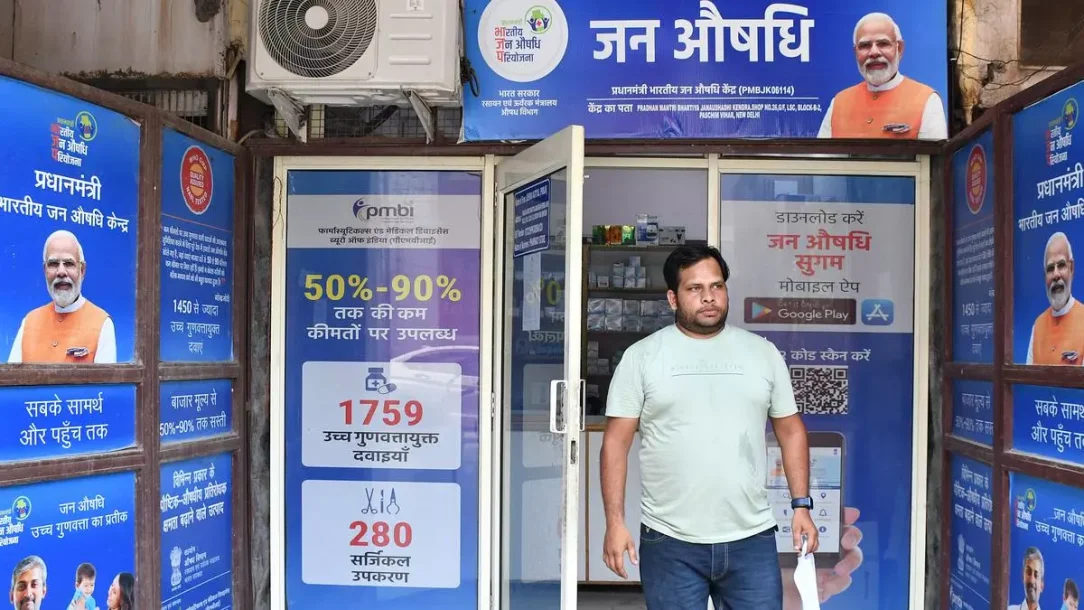
Walk into any government hospital in India and you will likely encounter a familiar scene: a prescription in hand, a chemist outside the gate, and a bill that hurts. Despite running one of the world's largest generic medicine manufacturing industries, India has long struggled to put affordable medicines into the hands of the people who need them most. For the country's poor and middle-class households, medicine expenditure is not an inconvenience — it is a financial trap.
On 19 November 2026, The Hindu carried a pointed analysis: a Union Minister has formally backed a proposal to integrate India Post's 1.56 lakh post offices with the Pradhan Mantri Bharatiya Janaushadhi Pariyojana (PMBJP) for last-mile delivery of generic medicines. This one development sits at the intersection of health governance, digital infrastructure, federalism, and social justice.
India's Healthcare Spending Crisis
India spends 1.43% of GDP on public health (2023-24 data), well short of the National Health Policy 2017's target of 2.5% of GDP by 2025. The consequence is predictable: citizens bear the burden themselves. Out-of-pocket expenditure (OOPE) in healthcare is among the highest in Asia, and medicines alone account for 60-70% of this OOPE. That is not a statistic. It is the story of a family selling assets to pay for a cancer treatment, or a diabetic patient rationing insulin doses because a branded medicine costs ten times what it should.
The economic logic for state intervention is clear: medicines are not a luxury consumer good. They are a necessity with inelastic demand, information asymmetry (the patient cannot easily evaluate quality), and significant market power for pharmaceutical brands. Jan Aushadhi is India's most direct answer to this problem.
What PMBJP Actually Is
The Pradhan Mantri Bharatiya Janaushadhi Pariyojana (PMBJP) is a government initiative that sells quality generic medicines at affordable prices through dedicated retail outlets called Jan Aushadhi Kendras (JAKs). The scheme is administered by the Department of Pharmaceuticals under the Ministry of Chemicals and Fertilizers, with implementation handled by the Pharmaceuticals and Medical Devices Bureau of India (PMBI).
A Brief History:
The scheme was launched in November 2008 by the UPA government but remained largely dormant. By 2014, it had only 240 stores across the country. The turnaround came after 2015, when the government relaunched and re-energised the scheme under PM Modi, initially calling it 'Pradhan Mantri Jan Aushadhi Yojana' and then renaming it PMBJP in November 2016. The growth since then has been dramatic.
|
Year |
JAK Stores |
Milestone |
|
2008 |
199 |
UPA scheme inception |
|
2014 |
240 |
Near-dormant state |
|
2017-18 |
3,193 |
Post-relaunch surge |
|
2020-21 |
7,557 |
COVID-era expansion |
|
2024-25 |
15,032 |
Target 25,000 set |
|
July 2026 |
20,547 |
Postal delivery proposal |
How the Kendra Model Works
PMBI does not manufacture medicines. It procures through competitive tenders from public and private manufacturers who must hold WHO-GMP certification. Medicines are sold at PMBI's fixed price — which averages 80% below the branded market rate. Kendra operators (individuals, NGOs, doctors, pharmacists, state/central government bodies) earn a margin on these sales, making the model self-sustaining. The current basket covers 2,110 medicines and 315 surgical items. Significantly, more than 35% of Jan Aushadhi Kendras are owned and run by women, making the scheme also a vehicle for women's economic empowerment.
What You Pay vs. What You Should Pay
Numbers make the case most powerfully. The table below compares Jan Aushadhi prices against market-priced branded equivalents :
|
Medicine (Strip of 10) |
Jan Aushadhi (₹) |
Market Price (₹) |
Saving (%) |
|
Atorvastatin 10 mg (cholesterol) |
8.25 |
79.63 |
~90% |
|
Pantoprazole 40 mg (acidity) |
11.35 |
181.00 |
~94% |
|
Amoxycillin 500 mg (antibiotic) |
32.80 |
117.00 |
~72% |
|
Cetirizine 10 mg (allergy) |
5.16 |
30.00 |
~83% |
|
Paracetamol 500 mg (fever) |
6.47 |
9.47 |
~32% |
|
Suvidha sanitary napkin (each) |
₹1.00 |
₹8-15 |
~87% |
The cumulative effect of these savings is staggering: citizens have saved approximately ₹45,000 crore over 12 years, with ₹9,000 crore saved in 2025-26 alone. The scheme now records a daily footfall of 10-12 lakh patients across its 20,547 kendras.
The India Post Proposal: When Two Government Networks Converge
The immediate trigger for today's news was an episode that exposed Jan Aushadhi's structural vulnerability. In May 2025, the Karnataka government discontinued Jan Aushadhi Kendras in government hospitals. Patients lost access overnight. It took a Karnataka High Court intervention in December 2025 to restore them. The lesson was stark: when Jan Aushadhi's presence depends entirely on state government decisions or private entrepreneurs, it can disappear. Enter a fresh idea from Parliament.
BJP Rajya Sabha MP Lahar Singh Siroya raised a special mention in Parliament proposing that the Health Ministry collaborate with the Department of Posts to expand Jan Aushadhi infrastructure. Union Communications Minister Jyotiraditya Scindia formally wrote to Siroya, calling the proposal 'appreciated' and noting it has 'significant potential to enhance access to affordable medicines, particularly in rural and remote areas.'
Why India Post Makes Sense
India Post operates 1.56 lakh post offices — the world's largest postal network — with deep penetration in remote tribal and rural areas where private entrepreneurs often do not find it commercially viable to open a kendra. Moreover, there is already a proven precedent: India Post already delivers medicines to ECHS (Ex-Servicemen Contributory Health Scheme) beneficiaries nationwide through a doorstep delivery service. The logistics infrastructure, the cold chain protocols, and the last-mile delivery experience all exist. What's being proposed is essentially an extension of a working model.
The integration could work in two ways: establishing physical Jan Aushadhi Kendras within post office premises (solving the real-estate and stability problem), and using India Post's logistics network for doorstep delivery of prescribed generic medicines to elderly, disabled, or geographically isolated patients. Under the Drugs and Cosmetics Act, 1940 (Rule 64), retail drug licences are currently restricted to fixed premises. Any doorstep delivery model would require appropriate regulatory amendments — this is a live policy challenge.
The Quality Question and the Doctor Prescription Problem
Quality: Perception vs. Reality
PMBI runs a two-tier quality assurance system: all suppliers must hold WHO-GMP certification and provide a Certificate of Analysis with every supply. PMBI then independently tests every batch at NABL-accredited laboratories against Indian Pharmacopoeia standards. Failed batches are recalled from all kendras and the supplier is blacklisted.
The official substandard rate for Jan Aushadhi medicines stands at 0.34%, compared to 3.70% in the open market. This is a critical fact for examinations. The public perception of inferior quality is therefore statistically unfounded, though a 2025 Kerala RTI study found a 4.2% failure rate in a smaller sample of Jan Aushadhi stocks — a discrepancy that underlines the need for the Indian Pharmacopoeia Commission's (IPC) random batch testing programme, which has since been commissioned.
The NMC Generic Prescription Directive
The National Medical Commission (NMC) originally directed all doctors to prescribe by International Non-proprietary Name (INN) — the generic name — rather than by brand. This was met with strong opposition from the Indian Medical Association (IMA), which argued it infringed on professional autonomy and accountability. The directive was put on hold. In April 2026, the NMC issued revised regulations reinstating the requirement and specifying that failure to prescribe generics may cost doctors their registration. The IMA has challenged this in court. If this regulation withstands legal scrutiny, it will structurally drive patients towards Jan Aushadhi Kendras — the most significant demand-side reform yet.
Odisha's Jan Aushadhi Story:
Odisha presents a compelling case study. The state has made genuine progress within the scheme, but glaring gaps remain — particularly for its large tribal population.
What Odisha Has Achieved
As of June 2026, Odisha has 881 operational Jan Aushadhi Kendras, placing it among the top-10 states by store count nationally. This is significant for a state whose total population is around 4.6 crore and which carries a high burden of poverty-related illness.
Of these, 21 JAKs are located in government premises — hospitals and health centres — where they serve patients who have already been consulted by a doctor. Chief Minister Mohan Majhi publicly hailed the Jan Aushadhi scheme as a 'boon for poor and middle-class families' on Jan Aushadhi Diwas 2026 (March 7), signalling political commitment from the highest office.
The Tribal Gap That Cannot Be Glossed Over
Here is the uncomfortable truth: Odisha's tribal-dominated districts — Malkangiri, Rayagada, Koraput, Nuapada, Kandhamal, and Nabarangpur — have the state's worst health indicators, the most difficult terrain, and the least commercial viability for private JAK operators. A PIB press release (February 2026) confirmed that Odisha has not submitted any proposal to the Centre for setting up Jan Aushadhi Vans for tribal and flood-prone districts. The Centre clarified that current regulations under Rule 64 of the Drugs and Cosmetics Act do not permit mobile medicine units, so licences cannot be issued for vans.
This creates a policy vacuum precisely where the need is greatest. Tribal communities in Odisha access healthcare primarily through government hospitals and PHCs, often walking several kilometres. Generic medicines at 80% discount could be life-changing — if only the kendra could reach them.
Why the India Post Solution Has Special Relevance for Odisha
Odisha has approximately 5,500+ post offices, including several in deep-interior tribal areas where India Post remains the government's most reliable ground presence. If the India Post-Jan Aushadhi integration proceeds, Odisha's tribal blocks — currently underserved by commercial JAK operators — could gain access to affordable medicines through the same infrastructure that delivers money orders and postal services. This is not just a convenience. For a state where 22.9% of the population belongs to Scheduled Tribes (Census 2011), it is a question of health equity.
The Constitutional and Policy Imperative
|
Constitutional/Policy Provision |
Relevance to Jan Aushadhi |
|
Article 21 (Right to Life) |
Supreme Court has interpreted Right to Life to include Right to Health and Right to live with dignity. Access to medicines is a subset of this. |
|
Article 47 (DPSP) |
The State shall endeavour to raise the level of nutrition and the standard of living and to improve public health. Jan Aushadhi is a direct instrument of this directive. |
|
Article 38 (DPSP) |
State shall strive to minimise inequalities in income and status — the scheme directly reduces health-driven economic inequalities. |
|
National Health Policy 2017 |
Targets: government health spending to reach 2.5% of GDP by 2025. Actual: 1.43% (2023-24). Gap creates imperative for supply-side interventions like Jan Aushadhi. |
|
Drugs and Cosmetics Act, 1940 (Rule 64) |
Currently restricts retail drug licences to fixed premises. Mobile/doorstep delivery requires rule amendment — this is the pending policy reform. |
What Still Needs to Be Fixed
Despite remarkable growth, four structural problems remain unresolved:
Awareness deficit: Studies show only 1 in 3 outpatients in some regions had heard of Jan Aushadhi. Without awareness, demand remains artificially low even where kendras exist.
Stock shortages and limited basket: Kendras frequently run out of specific medicines, sending patients back to commercial chemists. The 2,110-medicine basket does not cover all commonly prescribed drugs, creating gaps in patient adherence.
Perception as a poverty scheme: Many middle-class families associate Jan Aushadhi with charity, not quality. This misconception must be dismantled through sustained communication that positions kendras as "India's pharmacy of choice" — not the last resort.
Doctor resistance: Despite the NMC directive, most doctors continue prescribing by brand name under habit or pharmaceutical industry pressure. Until prescribing behaviour changes structurally, demand-side pull for JAKs remains limited.
Karnataka-type disruptions: State government decision-making can remove patients from access overnight. The India Post model addresses this by grounding distribution in Union Government infrastructure.
Way Forward:
The Jan Aushadhi scheme has outgrown its identity as a welfare scheme. It is now large enough — 20,547 stores, 10-12 lakh daily visits, Rs 45,000 crore in savings — to be treated as a national healthcare infrastructure. Scaling it further requires policy coherence across six dimensions:
Amend Rule 64, Drugs and Cosmetics Rules, 1945: Create a category for licensed mobile medical units and postal delivery of scheduled medicines. This is the single most important enabler for tribal and remote area access.
Implement the India Post-Jan Aushadhi integration: Pilot in 5-10 tribal districts across Odisha, Jharkhand, and Chhattisgarh first. Scale nationally after 12-month review. This is a low-cost, high-impact reform.
Mandate JAKs in every public hospital with 50+ beds: Of Odisha's 881 JAKs, only 21 are in government premises. This ratio is unacceptable. Every district hospital should have one.
Uphold and enforce the NMC generic prescription directive: The legal challenge by IMA should be defended vigorously. Generic prescription is the demand-side foundation without which supply-side expansion is hollow.
Launch an IPC-led public quality dashboard: Publish batch-level testing results online. Transparency on quality will build trust among the middle class who currently avoid Jan Aushadhi out of unfounded fear.
Increase public health spending towards the NHP 2017 target: The 1.43% GDP reality demands course correction. Universal access to generic medicines is a beginning, not a substitute for a fully-funded public health system.